Survodutide (BI 456906) is a once-weekly injectable peptide that activates two hormone receptors at once — GLP-1 and glucagon — and it is not approved anywhere. Its first Phase 3 obesity trial, SYNCHRONIZE-1, was published in the New England Journal of Medicine in June 2026 and reported mean weight loss of up to about 16.6% at 76 weeks among participants who stayed on treatment, against 3.2% on placebo.[16] That headline comes with real caveats about how it was measured, which this article unpacks rather than repeats.
Below: what the molecule is at a mechanistic level, why pairing glucagon-receptor agonism with GLP-1 receptor agonism is thought to matter, exactly what the Phase 2 and Phase 3 human data showed, what the side-effect profile looked like, and what remains unproven. Survodutide is co-developed by Boehringer Ingelheim and Zealand Pharma. Throughout it is treated strictly as an investigational compound in active clinical trials — not an approved medicine, and nothing here is dosing guidance or medical advice.
What Is Survodutide and Why Is It Being Studied?
Survodutide is a synthetic, acylated peptide engineered as a unimolecular dual agonist of the glucagon-like peptide-1 receptor (GLP-1R) and the glucagon receptor (GCGR). The word “unimolecular” is important: rather than combining two separate drugs, survodutide is a single molecule whose sequence has been tuned so that one peptide backbone can activate both receptors with a deliberately calibrated balance of potency.[3] Structurally it descends from oxyntomodulin, a naturally occurring gut hormone that itself activates both receptors, and it carries a C18 fatty-acid chain that extends its half-life enough to support once-weekly subcutaneous administration in trial protocols.[3]
The scientific interest in survodutide sits at the intersection of two of the largest unmet needs in cardiometabolic medicine: obesity and metabolic dysfunction-associated steatohepatitis (MASH, formerly called NASH). GLP-1 receptor agonists such as semaglutide reshaped obesity pharmacology by curbing appetite and improving glycemic control, but researchers hypothesized that recruiting the glucagon receptor could add a complementary axis — increased energy expenditure and enhanced hepatic fat handling — that a pure GLP-1 agonist cannot reach. Survodutide is one of the leading test cases for that hypothesis. For readers who want the foundational background on the single-receptor class first, our complete guide to what a GLP-1 is lays out how the parent pathway works before this dual-agonist layer is added.
Why does the field need another class of molecules at all, given how effective GLP-1 mono-agonists already are? The honest answer is that even the best GLP-1 drugs leave gaps. A meaningful fraction of the weight lost on appetite-suppressing agents is lean mass rather than fat; the metabolic-rate slowdown that accompanies caloric restriction blunts long-term efficacy; and GLP-1 mono-agonists were not designed to act directly on the liver, which is the organ that MASH damages. A molecule that could burn more energy, target hepatic fat directly, and still suppress appetite would, in principle, close several of those gaps at once. Survodutide is a concrete bet on that principle, and the reason it is studied so intensively is that the bet is testable: if the glucagon axis truly adds something, it should show up as extra weight loss, extra liver-fat reduction, and a distinct safety signature relative to GLP-1 alone.
As a reference point for how the compound is described in the research-supply literature, our survodutide dosage-protocol reference page catalogs the vial formats and reconstitution math used in laboratory settings. That page — like this article — frames survodutide as research-use-only material, not an approved therapeutic product available for human self-administration.
From Oxyntomodulin to BI 456906: The Roots of Dual Agonism
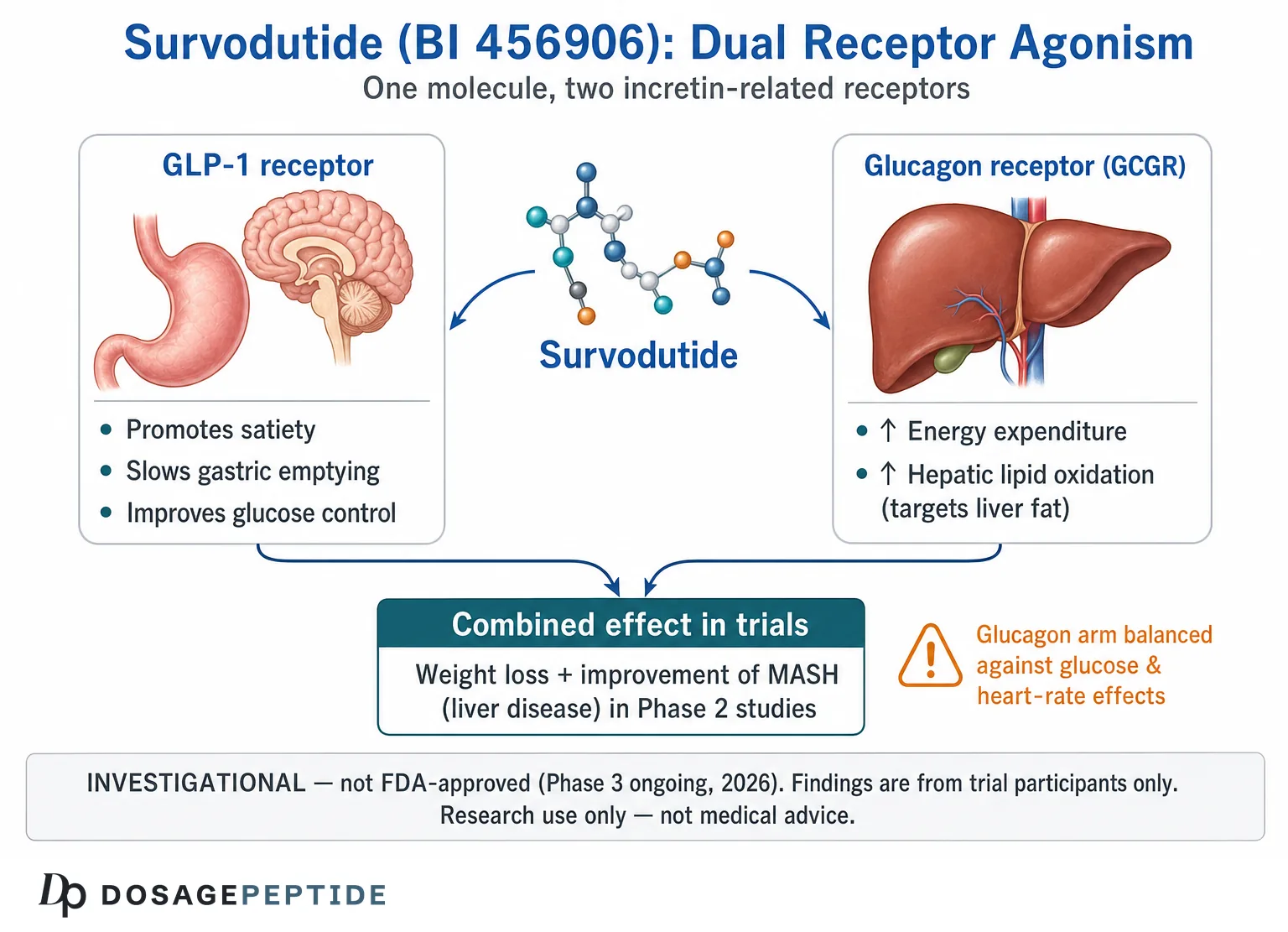
To appreciate why survodutide exists, it helps to start with the endogenous hormone that inspired it. Oxyntomodulin is a 37-amino-acid peptide released from intestinal L-cells after a meal, produced from the same proglucagon precursor that gives rise to GLP-1 and glucagon. Unlike either of those hormones, oxyntomodulin is a natural dual agonist: it activates both the GLP-1 receptor and the glucagon receptor, and it reduces bodyweight in humans by simultaneously increasing energy expenditure and reducing energy intake.[3] That dual profile is precisely the combination drug developers wanted to capture — but native oxyntomodulin is impractical as a medicine because it is degraded within minutes, requiring continuous or very frequent dosing.
The engineering problem, then, was to preserve oxyntomodulin’s balanced dual activity while giving it a half-life compatible with convenient dosing. Survodutide is the product of that effort. In the discovery and preclinical characterization published in Molecular Metabolism, the molecule is described as a potent, acylated peptide containing a C18 fatty acid as a “half-life-extending principle” designed to support once-weekly dosing in humans.[3] The fatty-acid chain allows the peptide to bind reversibly to serum albumin, which shields it from rapid clearance and stretches its dwell time in circulation from minutes to days — the same albumin-binding strategy used by several approved incretin drugs.
Confirming the molecule engages both receptors
A dual agonist is only as good as the proof that it truly hits both targets. The discovery work used a layered set of experiments to establish that BI 456906 engages the GLP-1R and the GCGR in living systems, not merely in a test tube. In cell-based in-vitro assays, the peptide showed functional agonism at both receptors. In animals, GLP-1R engagement was demonstrated through glucose-tolerance, food-intake, and gastric-emptying readouts, while GCGR engagement was tracked through liver nicotinamide N-methyltransferase (NNMT) messenger-RNA expression and circulating biomarkers including amino acids and fibroblast growth factor-21 (FGF-21).[3] The specificity of these effects was reinforced using GLP-1R knockout mice and transgenic reporter mice, plus an ex-vivo bioactivity assay — a design that isolates which physiological changes depend on which receptor.
These are elegant experiments, but it is worth stating plainly what tier of evidence they represent: they are cell-based and rodent studies. They establish, convincingly, that the molecule does what its designers intended at the receptor level, and they generate strong hypotheses about human physiology. They do not, on their own, demonstrate clinical benefit in people — that is the job of the human trials discussed later in this article. Keeping that boundary sharp is central to reading the survodutide literature honestly.
What Does “GLP-1/Glucagon Dual Agonist” Actually Mean?
To understand survodutide you first have to separate two hormones that sound like opposites. GLP-1 is an incretin: it is released from the gut after eating, amplifies glucose-dependent insulin secretion, slows gastric emptying, and signals satiety to the brain. Glucagon is classically taught as insulin’s counter-regulatory partner — it is released during fasting and raises blood glucose by stimulating hepatic glucose output. On the surface, deliberately activating the glucagon receptor in someone with metabolic disease looks paradoxical, even counterproductive, because it could raise blood sugar.
The resolution to that paradox is the concept of balanced co-agonism. Glucagon does far more than raise glucose. At the liver and in adipose and other tissues it increases energy expenditure, promotes lipolysis and fatty-acid oxidation, and can reduce hepatic fat content. The design bet behind a GLP-1/glucagon dual agonist is that GLP-1’s insulinotropic, appetite-suppressing, glucose-lowering effects can be used to offset the hyperglycemic tendency of glucagon, while glucagon’s thermogenic and hepatic-lipid effects add weight-loss and liver-directed benefits that GLP-1 alone does not deliver.[3] The therapeutic window depends entirely on getting the ratio of GCGR-to-GLP-1R activity right — too much glucagon signaling relative to GLP-1 could worsen glucose control; too little would waste the mechanistic advantage.
The receptor-balance problem
Every dual and triple agonist in this class is defined by its intrinsic potency ratio at each receptor. Survodutide, mazdutide, and the glucagon-containing arm of retatrutide each strike a different balance, which is one reason their clinical profiles are not interchangeable. Survodutide was characterized in preclinical work as a molecule with meaningful activity at both receptors, engineered so that GLP-1 signaling constrains the glycemic risk of concurrent glucagon signaling.[3] This is a fundamentally different problem from that faced by single-agonist drugs, and it is why the class is sometimes described as “polypharmacology in one molecule.”
A useful way to picture the balance problem is to imagine two dials on the same molecule. Turning up the GLP-1 dial buys appetite suppression, insulin secretion, and glucose lowering, but it also drives the gastrointestinal side effects characteristic of the class. Turning up the glucagon dial buys energy expenditure and direct hepatic fat oxidation, but it risks nudging glucose and heart rate upward. Because both dials are welded to a single peptide, the drug developer cannot adjust them independently in a patient — the ratio is fixed at the molecular level and can only be explored by testing different total doses. That constraint is why dose-finding trials matter so much for this class: the dose is the only lever left once the receptor ratio is baked in.
Where survodutide sits among its siblings
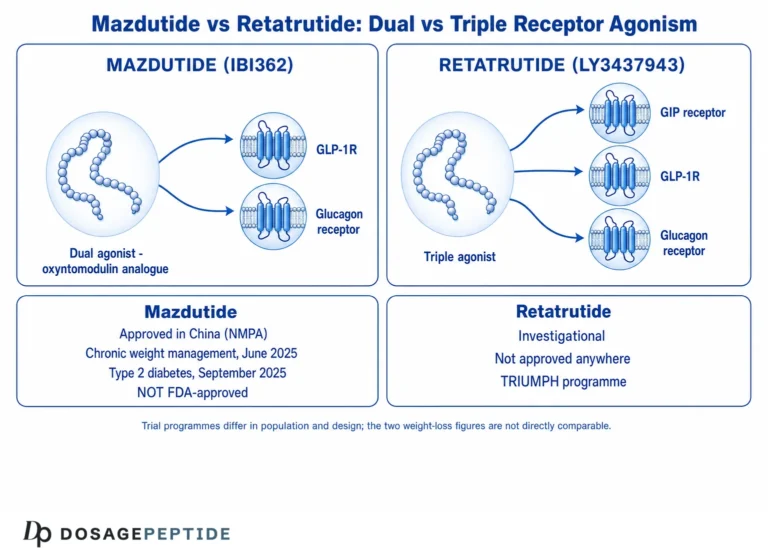
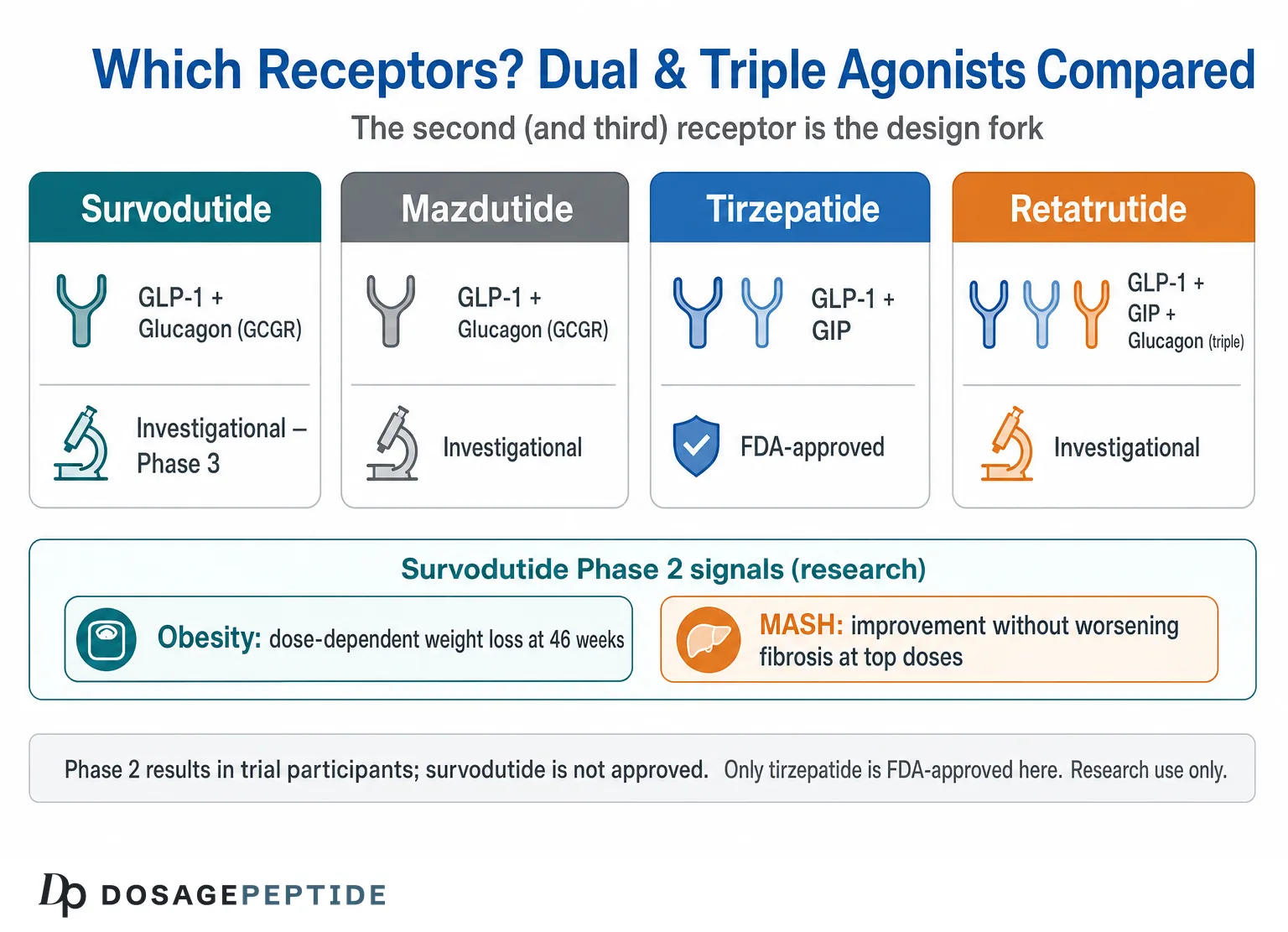
Survodutide is not alone. Mazdutide is a separate GLP-1/glucagon dual agonist built on a different (GLP-1/glucagon oxyntomodulin-like) scaffold, and retatrutide extends the idea to three receptors by adding GIP-receptor agonism. Understanding survodutide well means understanding what glucagon-receptor recruitment specifically contributes — the theme that runs through the rest of this article.
How Does Survodutide Work? The Mechanism of Dual Receptor Agonism
The survodutide mechanism can be split into two complementary limbs that map onto its two receptor targets. Each limb has been probed in preclinical models, and the combined phenotype is what distinguishes the molecule from GLP-1 mono-agonists.
The GLP-1 receptor limb
Through GLP-1R engagement, survodutide is expected to reproduce the familiar incretin effects: glucose-dependent enhancement of insulin secretion, suppression of inappropriate glucagon release in the fed state, delayed gastric emptying, and central appetite suppression that reduces energy intake. In the preclinical characterization, GLP-1R engagement was confirmed through glucose-tolerance, food-intake, and gastric-emptying readouts, and by loss of specific effects in GLP-1R knockout mice.[3] This limb is what keeps blood glucose in check and drives much of the reduction in food intake. It is also, in practical terms, the safety anchor of the whole molecule: the GLP-1 arm is what allows glucagon agonism to be added at all without the glucose penalty that a pure glucagon drug would carry.
The glucagon receptor limb
Through GCGR engagement, survodutide is thought to increase whole-body energy expenditure and to promote hepatic lipid oxidation — effectively increasing the amount of energy the body burns rather than only reducing how much it takes in. In the discovery paper, the anti-obesity efficacy of the molecule in mice exceeded that of a maximally effective dose of semaglutide, and mechanistic dissection attributed the additional effect specifically to increased energy expenditure combined with reduced food intake.[3] Glucagon-receptor engagement in vivo was tracked through liver biomarkers such as nicotinamide N-methyltransferase expression and circulating fibroblast growth factor-21 (FGF-21) and amino-acid changes.
Those biomarkers are worth pausing on, because they reveal how glucagon reshapes metabolism. FGF-21 is a hepatokine linked to fatty-acid oxidation and improved insulin sensitivity; its rise signals that the liver is shifting toward fat burning. Circulating amino acids fall when glucagon stimulates hepatic amino-acid catabolism — a hallmark of GCGR engagement that also feeds the liver-alpha-cell axis. The induction of NNMT in the liver is another fingerprint of glucagon action. Taken together, these readouts let researchers confirm, in a living animal, that the glucagon limb is genuinely active and not merely present on paper — a crucial validation for a molecule whose entire rationale rests on that second receptor pulling its weight.
More recent mechanistic work on long-acting glucagon analogues has begun to explain why the glucagon limb may matter most in obesity specifically. In diet-induced obese mice, glucagon-driven energy expenditure depended on hepatic — not adipose — glucagon-receptor signaling and on sustained cAMP/PKA activation, and, strikingly, the energy-expenditure effect appeared in obese but not lean animals.[6] The authors traced this obesity-specific pattern to sustained cAMP/PKA signaling driven by downregulation of the phosphodiesterases PDE4B/4D; in lean animals, those same phosphodiesterases rapidly quench the signal. They framed this obesity-specific enhancement as a plausible molecular reason that GCGR/GLP-1R dual agonists could outperform GLP-1 mono-agonists in people with obesity. It is important to read that finding for what it is: a mechanistic study in animal models that generates hypotheses about human dual agonists, not proof of a human clinical advantage.
The same study made a second point that has direct safety relevance. The lipid-clearing effects of the glucagon analogue were independent of the PDE4/cAMP/PKA axis that governed energy expenditure, meaning the fat-lowering and calorie-burning arms of glucagon action are at least partly separable at the molecular level.[6] That separability hints at a future in which the beneficial hepatic effects of glucagon could be preserved while its hyperglycemic risk is minimized — a translational goal, not an achieved fact, but one that helps explain the intensity of research into this receptor.
Why the liver is a special target
The glucagon limb is also why survodutide became a MASH candidate rather than only an obesity candidate. Because hepatocytes are rich in glucagon receptors, GCGR agonism can act directly on the liver to promote fat oxidation and reduce steatosis, on top of the systemic weight loss that GLP-1-driven appetite reduction produces. Liver fat can therefore fall through two convergent routes — direct hepatic action plus overall weight reduction — which is the rationale that motivated the dedicated MASH program discussed below.[7] This dual route is the mechanistic feature that most clearly separates survodutide from GLP-1 mono-agonists in the liver-disease setting, where reducing hepatic fat is the entry point to slowing inflammation and, eventually, fibrosis.
Why Add Glucagon-Receptor Agonism to a GLP-1 Drug?
If GLP-1 receptor agonists already produce substantial weight loss, why complicate the molecule? The research rationale rests on three arguments, each with a corresponding caveat.
Argument one: energy expenditure, not just energy intake. GLP-1 mono-agonists work largely by reducing how much a person eats. Over time the body defends against weight loss partly by lowering metabolic rate. Glucagon-receptor agonism is attractive because it can raise energy expenditure, potentially counteracting that adaptive slowdown and adding a second lever on the energy-balance equation.[3] The caveat is that increased energy expenditure must be balanced against tolerability and against the counter-regulatory rise in glucose that glucagon can cause.
Argument two: direct hepatic benefit. Because the glucagon receptor is highly expressed in the liver, adding GCGR agonism gives the molecule a tissue-specific mechanism for reducing hepatic fat and, hypothetically, addressing the inflammation and fibrosis that define MASH. This is the mechanistic basis for testing survodutide as a liver drug and not merely a weight-loss drug.[8]
Argument three: the possibility of deeper metabolic remodeling. By engaging complementary pathways, dual agonism could in principle improve lipids, liver enzymes, and body composition in ways single agonism does not. The caveat here is the one that recurs throughout translational medicine: mechanistic plausibility and animal efficacy do not guarantee that the same advantage materializes, or is well tolerated, in humans.
The trade-off that defines the class
The central engineering tension is glucose and heart rate. Glucagon agonism can push blood glucose up and, like the whole incretin class, these agents tend to raise resting heart rate modestly. The entire promise of a balanced dual agonist is that GLP-1’s glucose-lowering more than compensates for glucagon’s glucose-raising, netting out to improved glycemic control alongside the added fat-burning. Whether that balance holds across doses, populations, and long durations is precisely what the clinical program is designed to test — and why the glucagon arm is described as the differentiator and the risk.
A note on the escalation schedule as a design variable
One under-appreciated reason the glucagon arm is manageable in practice is the way doses are introduced. Across the survodutide trials, investigators used multi-week dose-escalation phases — 20 weeks in the obesity study and 24 weeks in the MASH study — before reaching maintenance doses.[1][2] Escalation is not a cosmetic detail: it lets the body adapt to the incretin effect and blunts the gastrointestinal side effects that otherwise drive people off treatment. The diabetes study made this explicit, concluding that dose-related gastrointestinal adverse events could be mitigated with slower escalations.[4] This means that any comparison of survodutide’s tolerability to another agent must account for how quickly each was titrated, not just the final dose.
What Did the Phase 2 Obesity Trial Show?
The pivotal early-efficacy readout in obesity came from a randomized, double-blind, placebo-controlled, dose-finding Phase 2 trial published in The Lancet Diabetes & Endocrinology (le Roux and colleagues), conducted across 43 centers in 12 countries and registered as NCT04667377.[1][9] The trial enrolled 387 adults (BMI ≥27 kg/m², without diabetes) and randomly assigned them 1:1:1:1:1 to once-weekly subcutaneous survodutide at 0.6, 2.4, 3.6, or 4.8 mg or placebo, with a 20-week dose-escalation period followed by 26 weeks of maintenance, for 46 weeks total. The primary endpoint was the percentage change in bodyweight from baseline to week 46.
The headline weight-loss numbers
Analyzed by planned treatment, mean body-weight change from baseline to week 46 was dose-dependent: about −6.2% at 0.6 mg, −12.5% at 2.4 mg, −13.2% at 3.6 mg, and −14.9% at the top 4.8 mg dose, compared with roughly −2.8% for placebo.[1] In other words, the highest tested dose produced mean weight loss in the high-teens-of-percent range relative to placebo. The following table summarizes the reported means for trial participants.
| Assigned arm (once weekly) | Mean weight change at week 46 |
|---|---|
| Placebo | −2.8% |
| Survodutide 0.6 mg | −6.2% |
| Survodutide 2.4 mg | −12.5% |
| Survodutide 3.6 mg | −13.2% |
| Survodutide 4.8 mg | −14.9% |
Important context on these results
Several caveats keep these numbers honest. First, only about 60% of participants completed the full 46-week treatment period (233 of 386 treated participants; 61% of survodutide recipients and 60% of placebo recipients), and the escalation schedule was relatively rapid — both factors shape how the averages should be read.[1] Second, adverse events, predominantly gastrointestinal, were common: they occurred in roughly 91% of survodutide recipients versus 75% of placebo recipients, with gastrointestinal events specifically in about 75% of survodutide recipients versus 42% on placebo.[1] Third, this was a dose-finding Phase 2 study whose purpose was to characterize the dose-response relationship and tolerability — not to establish long-term efficacy or safety, which is the job of the Phase 3 program. The investigators concluded that all tested doses were tolerated and dose-dependently reduced body weight, explicitly framing the result as a rationale for further study.
A methodological point deserves emphasis because it affects how the headline figure should be interpreted. The primary analysis was based on the dose assigned at randomization (“planned treatment”) and included data censored for COVID-19-related discontinuations, while a sensitivity analysis used the actual maintenance dose received (“actual treatment”) with on-treatment data only.[1] The two framings answer subtly different questions — the planned-treatment estimate reflects the intention-to-treat spirit, whereas an on-treatment estimate tends to look larger because it emphasizes people who tolerated the drug. Readers who see a single “survodutide produced X% weight loss” headline should know that the exact number depends on which analysis is quoted; the figures in this article are the planned-treatment means.
It is also worth noting what the trial did not show. Because the escalation phase occupied a large share of the study window and the trial ended at 46 weeks, the weight-loss curves had not clearly plateaued at every dose, meaning the ceiling of effect for survodutide in obesity remained an open question at Phase 2. That question is one of several the Phase 3 obesity studies were designed to answer, and, as discussed below, the first of those readouts has now arrived.
What Did the Phase 2 MASH Trial Reveal?
The liver program produced the result that arguably distinguishes survodutide most sharply from pure GLP-1 agonists. In a 48-week Phase 2 trial published in the New England Journal of Medicine (Sanyal and colleagues, NCT04771273), 293 adults with biopsy-confirmed MASH and fibrosis stage F1 through F3 were randomized 1:1:1:1 to once-weekly subcutaneous survodutide at 2.4, 4.8, or 6.0 mg or placebo, again using a 24-week rapid escalation followed by a 24-week maintenance phase.[2][10]
The primary histologic endpoint
The primary endpoint was histologic improvement in MASH with no worsening of fibrosis. Improvement in MASH without fibrosis worsening occurred in 47% of participants in the 2.4-mg group, 62% in the 4.8-mg group, and 43% in the 6.0-mg group, compared with just 14% in the placebo group, with a statistically significant dose-response (best fit by a quadratic model, p<0.001 for the dose-response curve).[2] The 4.8-mg dose looked most favorable on this endpoint — a reminder that in balanced dual agonism, the highest dose is not automatically the best. The fact that the best-fitting model was quadratic rather than strictly linear is itself informative: it suggests that pushing the dose to 6.0 mg did not buy additional histologic benefit and may have shifted the tolerability balance, exactly the kind of nuance a dose-finding trial exists to surface.
| Arm | MASH improvement, no fibrosis worsening | ≥30% liver-fat reduction | Fibrosis improvement ≥1 stage |
|---|---|---|---|
| Placebo | 14% | 14% | 22% |
| Survodutide 2.4 mg | 47% | 63% | 34% |
| Survodutide 4.8 mg | 62% | 67% | 36% |
| Survodutide 6.0 mg | 43% | 57% | 34% |
Secondary endpoints and how to read them
Secondary endpoints reinforced the liver-directed hypothesis. A reduction in liver fat content of at least 30% occurred in 57–67% of survodutide-treated participants versus 14% on placebo, and improvement in fibrosis by at least one stage occurred in 34–36% of survodutide arms versus 22% on placebo.[2] The fibrosis-improvement difference was more modest and less clearly separated from placebo than the steatohepatitis-resolution difference — an honest reading is that survodutide showed a strong signal on MASH activity and liver fat, and a more preliminary signal on fibrosis regression that will need the larger, longer Phase 3 trials to confirm. Indeed, the placebo fibrosis-improvement rate of 22% is a useful reminder of how noisy single biopsy-based fibrosis staging can be over less than a year, which is one reason regulators want multi-year outcome data before treating a fibrosis claim as established.
Tolerability in the MASH trial mirrored the obesity data: nausea (66% vs. 23% placebo), diarrhea (49% vs. 23%), and vomiting (41% vs. 4%) were the most common adverse events, and serious adverse events occurred in 8% of survodutide participants versus 7% on placebo.[2] The authors concluded survodutide was superior to placebo for MASH improvement without worsening fibrosis and that the result warranted Phase 3 investigation.
Extending the liver program into cirrhosis
Because people with advanced liver disease are usually excluded from early trials, a separate Phase 1 study specifically examined survodutide in cirrhosis — an important gap-filler for a liver-directed drug.[5] In this multinational, non-randomized, open-label trial, investigators first gave a single 0.3-mg subcutaneous dose to people with Child-Pugh class A, B, or C cirrhosis and to matched healthy individuals, measuring pharmacokinetics; drug exposure (area under the curve and peak concentration) was similar in those with cirrhosis and healthy participants, with the 90% confidence intervals for the adjusted ratios spanning 1. A second cohort of people with overweight or obesity, with or without Child-Pugh A or B cirrhosis, then received once-weekly doses escalated from 0.3 mg to 6.0 mg over 24 weeks and maintained for four more weeks.
Over 28 weeks of treatment, drug-related adverse events occurred in about 82–88% of the multiple-dose cohorts, and exploratory metabolic readouts — liver fat content, liver stiffness, liver volume, body weight, and other hepatic and metabolic markers — were generally reduced.[5] The authors concluded that survodutide is generally tolerable in people with compensated or decompensated cirrhosis, does not require pharmacokinetic-based dose adjustment for cirrhosis, and may improve liver-related non-invasive tests — supporting further investigation for MASH-related cirrhosis while remaining early-stage, small-sample, open-label evidence. That last qualifier matters: an open-label study with exploratory endpoints generates encouraging signals and answers a specific dosing question, but it cannot substitute for the randomized, controlled cirrhosis-outcome trial now underway in Phase 3.
How Does Survodutide Compare to Other Incretin-Based Compounds?
Survodutide is best understood against the broader map of incretin-based agents, because its glucagon component is exactly what separates it from the GLP-1-only and GLP-1/GIP drugs that dominate the field.
Versus GLP-1 mono-agonists (e.g., semaglutide)
Semaglutide is an approved GLP-1 receptor agonist. Survodutide adds the glucagon-receptor axis on top of GLP-1 signaling, and in preclinical models this addition drove greater weight loss than a maximally effective semaglutide dose — attributed to the extra energy-expenditure component.[3] In a Phase 2 study in people with type 2 diabetes, survodutide reduced HbA1c and produced dose-dependent weight loss, with higher doses producing greater body-weight reductions than open-label semaglutide in that trial, though at the cost of more gastrointestinal adverse events.[4] These are separate-trial, cross-study observations, not head-to-head superiority claims in the regulatory sense.
The diabetes trial in more detail
The diabetes study is worth unpacking because it directly tested the glucagon paradox — can a glucagon-activating drug still lower blood sugar? Published in Diabetologia (Blüher and colleagues, NCT04153929), this Phase 2 trial randomized 413 adults with type 2 diabetes on background metformin to survodutide across several once-weekly or twice-weekly dose groups, to placebo, or to open-label semaglutide up to 1.0 mg once weekly.[4] After 16 weeks, adjusted mean HbA1c fell across the survodutide dose groups by roughly 0.9% to 1.7% (about 10 to 19 mmol/mol) from a baseline near 8.1%. The reduction with low-dose survodutide (about −1.46%) was similar to that seen with semaglutide (about −1.47%) in the same trial. Bodyweight decreased dose-dependently, reaching up to about −8.7% in the highest survodutide group, and survodutide at doses of at least 1.8 mg weekly produced greater weight loss than semaglutide’s roughly −5.3%. Adverse events — mainly gastrointestinal — were reported in about 78% of survodutide-treated participants versus roughly 52% for both placebo and semaglutide.
The critical takeaway is that a molecule deliberately engaging the glucagon receptor still lowered HbA1c, which is the clearest available evidence that, at the doses and receptor balance tested, the GLP-1 limb’s glucose-lowering prevailed over glucagon’s glucose-raising tendency.[4] That is a genuine validation of the balanced-agonism concept in humans, though only over a short 16-week window and in a population already on metformin. The higher gastrointestinal adverse-event rate relative to semaglutide is the flip side of the greater weight loss and again points to escalation speed as a lever for tolerability.
Versus the other GLP-1/glucagon dual agonist (mazdutide)
Mazdutide shares survodutide’s receptor pairing but is a distinct molecule with its own potency balance and its own trial program. Comparing the two is a study in how much the specific GCGR-to-GLP-1R ratio and the escalation schedule matter to the clinical profile. Readers exploring both should see our dedicated explainer on mazdutide alongside its reference protocol page for how the research-supply literature catalogs it.
Versus the triple agonist (retatrutide)
Retatrutide extends the concept to three receptors — GLP-1, glucagon, and GIP — and has generated some of the largest weight-loss figures reported in the class in Phase 2. Whether adding GIP agonism to the GLP-1/glucagon backbone yields a better efficacy-tolerability balance than survodutide’s two-receptor design is an open comparative question. Our retatrutide overview, its reference protocol page, and the broader retatrutide vs. semaglutide vs. tirzepatide comparison map out how the mono-, dual-, and triple-agonist strategies differ. The essential point for survodutide is that its identity is defined by glucagon-receptor recruitment without GIP — a deliberately narrower, more liver-focused design than the triple agonists. A crucial methodological warning applies to all of these comparisons: the figures come from separate trials with different populations, baseline weights, durations, and escalation schedules, so they cannot establish which molecule is superior. Only direct head-to-head randomized trials can do that, and for these newer agents few such trials exist.
What Is the Current Evidence Level for Survodutide?
Stating the evidence tier precisely is the most important thing this article can do, because it is easy to over-read promising trial numbers. Here is the honest status as of 2026:
- Regulatory status: investigational, NOT approved. Survodutide is not approved by the FDA, EMA, or any comparable regulator for obesity, MASH, type 2 diabetes, or any other indication. It cannot be prescribed as an approved therapy; it exists in clinical trials and as research-grade material. In September 2024 the FDA granted survodutide a Breakthrough Therapy designation for non-cirrhotic MASH with moderate-to-advanced fibrosis, but a Breakthrough Therapy designation is a mechanism to expedite development and review — it is emphatically not a marketing approval and does not permit clinical use.[15]
- Highest completed human evidence: Phase 2, with the first Phase 3 obesity readout now reported. The strongest peer-reviewed human data remain the Phase 2 obesity trial[1] and the Phase 2 MASH trial,[2] supported by Phase 2 diabetes[4] and Phase 1 cirrhosis[5] data. The Phase 3 SYNCHRONIZE-1 obesity trial has now been published in the New England Journal of Medicine (June 2026), which moves the obesity evidence from company topline to peer-reviewed randomized data.[16]
- Mechanistic and preclinical foundation: robust but animal/in-vitro. The pharmacology and much of the energy-expenditure mechanism rest on cell-based assays and rodent models.[3][6] These support the rationale but cannot substitute for confirmatory human outcome data.
- Phase 3: partially reported, liver and cardiovascular outcomes still maturing. The confirmatory program spans obesity, MASH, and cardiovascular safety; the obesity and cardiovascular-safety studies have reached primary completion, while the liver-outcome trials run for several more years.
In plain terms: survodutide has promising, peer-reviewed, randomized Phase 2 human evidence in obesity and MASH, a positive but not-yet-published Phase 3 obesity topline, a solid preclinical mechanism, and no approved indication. Any statement that survodutide “treats,” “cures,” or is “proven” for a disease would overstate the current evidence. The accurate framing is that it is an investigational compound demonstrating dose-dependent effects in trial participants and now being tested for confirmation and, potentially, future regulatory review.
What Does the Phase 3 SYNCHRONIZE Program Include?
The Phase 3 evidence that will determine survodutide’s future is being generated by a large, multi-study program — branded SYNCHRONIZE for obesity and LIVERAGE for liver disease — spanning both indications. Registered Phase 3 trials sponsored by Boehringer Ingelheim include obesity efficacy-and-safety studies, dedicated MASH/liver-outcome studies, and a large cardiovascular-safety study — reflecting a strategy of testing survodutide across the metabolic-disease spectrum rather than in a single indication.
What did the Phase 3 SYNCHRONIZE-1 trial actually find?
The obesity backbone includes 76-week efficacy-and-safety trials in adults with overweight or obesity without type 2 diabetes (SYNCHRONIZE-1, NCT06066515) and with type 2 diabetes (SYNCHRONIZE-2, NCT06066528), plus region-specific studies. These are the trials designed to define survodutide’s durable weight-loss efficacy and its tolerability over a longer horizon than Phase 2 allowed.[11]
SYNCHRONIZE-1 randomised roughly 725 adults with a BMI above 30, or above 27 with at least one weight-related complication and no diabetes, across 116 sites in 14 countries, to once-weekly subcutaneous survodutide titrated up to 3.6 mg, up to 6.0 mg, or placebo, over 76 weeks. It met its co-primary endpoints and was published in the New England Journal of Medicine on 7 June 2026.[16]
| SYNCHRONIZE-1 at 76 weeks | 3.6 mg | 6.0 mg | Placebo |
|---|---|---|---|
| Mean weight change — treatment-regimen estimand (everyone randomised, whatever they did next) | −12% | −13% | −5% |
| Mean weight change — efficacy estimand (participants who stayed on treatment) | — | up to −16.6% | −3.2% |
| Achieved at least 5% weight reduction | 73% | 72% | 46% |
| Gastrointestinal adverse events (mostly mild–moderate) | 81% | 90% | 48% |
The two estimands are the single most important thing to understand about that table, and the reason the same trial is quoted as both “13%” and “16.6%”. The efficacy estimand asks what happens to people who take the drug as intended; the treatment-regimen estimand asks what happens to everyone who was randomised, including those who stopped. The gap between them — roughly three to four percentage points — is the real-world cost of discontinuation, and the trial authors themselves flagged the number of participants who left the regimen as a limitation. A headline that quotes only the higher figure is not wrong, but it is describing the better of two legitimate answers.
An MRI substudy at the 6.0 mg dose reported a 63.1% reduction in liver fat and a 34.0% reduction in visceral fat, alongside a 9.8% decline in lean volume — a fat-selective pattern that is consistent with the glucagon-receptor rationale described earlier, and a lean-mass figure that deserves to be quoted alongside it rather than omitted. No deaths were reported in the trial.[17]
The MASH/liver Phase 3 studies
On the liver side, the program includes a Phase 3 trial in non-cirrhotic MASH with F2–F3 fibrosis (LIVERAGE, NCT06632444) and a study in participants with compensated MASH cirrhosis (LIVERAGE-Cirrhosis, NCT06632457), the latter evaluating liver-related clinical outcomes over a multi-year horizon.[12] These liver-outcome trials are the ones that could, if positive, move survodutide from “improves histology in Phase 2” toward demonstrated clinical benefit — but their primary-completion timelines extend years into the future, into the late 2020s and beyond. It is precisely because the liver questions are the hardest and slowest to answer that the FDA’s Breakthrough Therapy designation in this indication is meaningful for the development timeline, even though it changes nothing about the drug’s current unapproved status.
The cardiovascular-safety study
A large, event-driven cardiovascular-safety study (SYNCHRONIZE-CVOT, NCT06077864) enrolling several thousand participants with overweight or obesity plus cardiovascular disease, chronic kidney disease, or multiple risk factors is also part of the program.[13] A cardiovascular-outcomes trial of this size matters especially for a glucagon-containing molecule, because the glucagon axis’s effects on heart rate and glucose make long-term cardiovascular safety a first-order question rather than an afterthought. Even as the obesity and cardiovascular-safety studies reach primary completion, the full analysis, publication, and regulatory review of these datasets remain in progress; until that process concludes, survodutide’s long-term cardiovascular and safety profile is best described as not yet formally established.
What Are the Safety Signals and Tolerability Observations So Far?
Because survodutide is investigational, its safety profile is described here only as observations from trial participants, not as an established profile and not as guidance for use.
Gastrointestinal effects dominate the tolerability picture
Across the Phase 2 obesity, MASH, and diabetes trials, the most consistent finding is a high rate of gastrointestinal adverse events — nausea, vomiting, and diarrhea — substantially more frequent than placebo.[1][2] This is characteristic of the incretin class as a whole and appears related to the pace of dose escalation; the diabetes trial explicitly noted that dose-related gastrointestinal events could be mitigated with slower escalation.[4] The relatively rapid escalation used in the Phase 2 studies likely contributed to the high adverse-event rates and to the notable discontinuation seen in the obesity trial. One reasonable expectation for Phase 3 — where escalation was stretched over a longer window — is a somewhat gentler tolerability profile, though that must be confirmed in the published data rather than assumed.
The glucagon-specific questions
The theoretically distinctive safety questions for a GLP-1/glucagon dual agonist — as opposed to a GLP-1 mono-agonist — center on glucose and heart rate. Glucagon-receptor agonism can raise blood glucose, so the net glycemic effect depends on GLP-1 dominance; the diabetes trial’s finding that survodutide reduced HbA1c indicates that, at the doses and balance tested, the GLP-1 limb’s glucose-lowering prevailed.[4] Heart-rate increases are common across incretin therapies and are one reason the dedicated cardiovascular-safety trial exists. None of these questions can be considered resolved at the Phase 2 stage, and the glucagon axis’s effects on resting heart rate in particular are exactly the kind of signal that only a large, long cardiovascular-outcomes trial is powered to characterize.
What we do not yet know
Serious adverse events in the MASH trial were similar between survodutide and placebo (8% vs. 7%),[2] which is reassuring at the scale studied, but Phase 2 trials are not powered to detect uncommon serious risks, and their durations are too short to characterize long-term effects on body composition (including lean mass), bone, or rare adverse events. The safety verdict genuinely awaits the larger, longer Phase 3 dataset, including the completed obesity and cardiovascular-safety studies once they are fully reported.
What Are the Limitations of the Current Survodutide Evidence?
A responsible reading of survodutide requires foregrounding what the existing evidence cannot yet support.
Trial-stage limitations
Peer-reviewed evidence is still mostly Phase 2. Every efficacy figure that has been through full peer review here comes from dose-finding or early-efficacy Phase 2 trials. These are excellent for generating hypotheses about the right dose and for showing that an effect exists, but they are not designed to confirm durable benefit or to characterize long-term safety. The Phase 3 obesity topline is promising but, as of this writing, remains a sponsor announcement pending full publication, and the confirmatory liver-outcome trials had not reported.
Short durations and high discontinuation. The obesity trial ran 46 weeks with roughly 60% completion, and the MASH trial ran 48 weeks.[1][2] Obesity and MASH are chronic conditions managed over years; single-year data cannot speak to durability, weight regain after discontinuation, or long-term fibrosis outcomes. The 76-week Phase 3 obesity design directly addresses the durability question, but even 76 weeks is short relative to a lifelong condition.
Interpretive limitations
Surrogate endpoints. The MASH trial’s primary endpoint was histologic improvement — a validated surrogate, but still a surrogate. What ultimately matters clinically is whether survodutide reduces hard liver outcomes such as progression to cirrhosis, hepatic decompensation, or liver-related death, which is what the multi-year Phase 3 outcome trials are built to measure.[8] Weight loss, liver-fat percentage, and HbA1c are likewise intermediate measures; they correlate with better outcomes but are not the outcomes themselves.
Fibrosis signal is preliminary. The at-least-one-stage fibrosis-improvement difference from placebo was modest, and the primary endpoint deliberately required only “no worsening” of fibrosis rather than fibrosis regression.[2] Claiming survodutide “reverses fibrosis” would overstate the data.
Cross-study comparisons are not head-to-head. Comparisons to semaglutide, mazdutide, or retatrutide drawn from separate trials with different populations and designs are informative but cannot establish superiority. Only direct comparative trials can do that, and few exist for these newer agents. The one within-trial semaglutide comparison — in the diabetes study — was open-label for the semaglutide arm, which further limits how strongly it can be read.[4]
Translational limitations
Mechanism rests partly on animal models. The obesity-specific energy-expenditure mechanism and the receptor-balance characterization derive substantially from rodent and in-vitro work.[3][6] Human physiology may diverge, and the precise contribution of the glucagon limb to human weight loss and liver improvement has not been isolated in people.
Research-grade material is not a regulated product. Survodutide sold as research material is not an approved medicine, is not manufactured to pharmaceutical standards for human administration, and has no established human dosing outside a supervised clinical trial. Its appropriate use is confined to legitimate laboratory research contexts.
Frequently Asked Questions
Is survodutide FDA-approved?
No. As of 2026, survodutide (BI 456906) is investigational and has not been approved by the FDA, EMA, or any comparable regulator for obesity, MASH, type 2 diabetes, or any other indication. It received an FDA Breakthrough Therapy designation for non-cirrhotic MASH with moderate-to-advanced fibrosis in 2024, which is a program to speed up development and review — not an approval and not permission for clinical use. It is being evaluated in Phase 3 trials, the first of which (SYNCHRONIZE-1, in obesity) reported positive topline results in 2026. Outside a supervised clinical trial, it exists only as research-use-only material rather than a regulated medicine.
What makes survodutide different from semaglutide?
Semaglutide activates only the GLP-1 receptor, whereas survodutide is a dual agonist that activates both the GLP-1 receptor and the glucagon receptor. The added glucagon-receptor arm is thought to increase energy expenditure and act directly on the liver to reduce fat, mechanisms a pure GLP-1 agonist does not engage. In preclinical models this dual mechanism produced greater weight loss than a maximal semaglutide dose, and in a Phase 2 diabetes trial higher survodutide doses reduced weight more than semaglutide — though human superiority has not been formally established in head-to-head registration trials.
How much weight did survodutide produce in trials?
In the Phase 2 obesity trial (NCT04667377), mean body-weight loss at week 46 was dose-dependent, reaching approximately −14.9% at the highest 4.8-mg dose versus about −2.8% for placebo, per planned-treatment analysis. In 2026, the Phase 3 SYNCHRONIZE-1 trial reported topline mean weight loss of about 16.6% at 76 weeks versus about 3.2% on placebo. These are averages in trial participants, not guaranteed individual outcomes, and the Phase 3 figure comes from a sponsor announcement awaiting full peer-reviewed publication.
What did the survodutide MASH trial show?
In the 48-week Phase 2 MASH trial (NCT04771273) published in the New England Journal of Medicine, histologic improvement in MASH without worsening of fibrosis occurred in up to 62% of survodutide-treated participants (at 4.8 mg) versus 14% on placebo, with a significant dose-response. At least a 30% reduction in liver fat occurred in 57–67% of survodutide arms versus 14% on placebo. The fibrosis-improvement signal (34–36% vs. 22% placebo) was more modest, and confirmatory Phase 3 liver-outcome trials are ongoing.
Why does adding glucagon agonism not just raise blood sugar?
Glucagon can raise blood glucose, but in a balanced dual agonist the GLP-1 component’s glucose-lowering and insulin-enhancing effects are designed to more than offset it. In the Phase 2 diabetes study, survodutide actually reduced HbA1c by roughly 0.9–1.7% over 16 weeks, indicating that at the tested doses the GLP-1 limb’s glycemic effect prevailed. The net glucose effect depends on getting the receptor-potency balance right, which is central to the molecule’s engineering.
How does survodutide compare to retatrutide and mazdutide?
Mazdutide is another GLP-1/glucagon dual agonist with a different potency balance and separate trial program, while retatrutide is a triple agonist that adds GIP-receptor activity. Survodutide’s identity is dual GLP-1/glucagon agonism without GIP, giving it a comparatively liver-focused design. Cross-trial numbers suggest all are potent, but they come from separate studies with different populations and designs, and there are few direct head-to-head trials, so relative rankings remain uncertain.
Is survodutide safe?
Its safety profile is still being established. In Phase 2 trials the most common adverse events were gastrointestinal — nausea, vomiting, and diarrhea — occurring far more often than placebo, and partly related to how quickly the dose was escalated. Serious adverse events in the MASH trial were similar to placebo (8% vs. 7%). Glucagon-related effects on glucose and heart rate are specific questions under study, and a large Phase 3 cardiovascular-safety trial addresses them. Long-term and rare risks are not yet fully characterized.
What is the SYNCHRONIZE program?
SYNCHRONIZE is the name of survodutide’s Phase 3 obesity program, part of a broader set of confirmatory trials that also includes the LIVERAGE MASH and liver-cirrhosis outcome studies and a large cardiovascular-safety trial (SYNCHRONIZE-CVOT). These trials are designed to establish long-term efficacy and safety across the metabolic-disease spectrum. The first obesity readout (SYNCHRONIZE-1) reported positive topline results in 2026, while several of the liver-outcome studies have multi-year timelines extending into the late 2020s.
Can survodutide be used for research purposes?
Survodutide is described in the research-supply literature as research-use-only material and is not an approved product for human administration. Legitimate use is confined to controlled laboratory research contexts and properly regulated clinical trials. This article is an educational reference and does not provide dosing instructions, protocols for human use, or medical advice of any kind.
Research-Use-Only Disclaimer
This article is an independent educational reference intended for scientists, students, and informed readers seeking to understand the biology and clinical-research status of survodutide (BI 456906). Dosagepeptide.com is not a seller, pharmacy, or clinic. Survodutide is an investigational compound that is not approved by the FDA or any comparable regulator for any use. Nothing here is medical advice, a treatment recommendation, or a suggestion to obtain or self-administer any substance. Any material referred to as “research grade” is described as research-use-only and is not a medicine for human consumption. The trial findings summarized above describe results observed in clinical-trial participants and animal or laboratory models; they do not establish that survodutide is safe or effective for any individual. Consult a qualified, licensed healthcare professional for any medical question, and rely on primary sources and regulatory labeling — not this article — for clinical decisions.
References
- le Roux CW, Steen O, Lucas KJ, et al. Glucagon and GLP-1 receptor dual agonist survodutide for obesity: a randomised, double-blind, placebo-controlled, dose-finding phase 2 trial. Lancet Diabetes Endocrinol. 2024;12(3):162–173. PubMed 38330987.
- Sanyal AJ, Bedossa P, Fraessdorf M, et al. A Phase 2 Randomized Trial of Survodutide in MASH and Fibrosis. N Engl J Med. 2024;391(4):311–319. PubMed 38847460.
- Zimmermann T, Thomas L, Baader-Pagler T, et al. BI 456906: Discovery and preclinical pharmacology of a novel GCGR/GLP-1R dual agonist with robust anti-obesity efficacy. Mol Metab. 2022;66:101633. PubMed 36356832.
- Blüher M, Rosenstock J, Hoefler J, et al. Dose-response effects on HbA1c and bodyweight reduction of survodutide, a dual glucagon/GLP-1 receptor agonist, compared with placebo and open-label semaglutide in people with type 2 diabetes: a randomised clinical trial. Diabetologia. 2024;67(3):470–482. PubMed 38095657.
- Lawitz EJ, Fraessdorf M, Neff GW, et al. Efficacy, tolerability and pharmacokinetics of survodutide, a glucagon/GLP-1 receptor dual agonist, in cirrhosis. J Hepatol. 2024;81(5):837–846. PubMed 38857788.
- Long F, Challa TD, Ding L, et al. Glucagon controls obesity-specific energy expenditure via persistent cAMP/PKA signaling. J Hepatol. 2025;83(6):1379–1391. PubMed 40550339.
- Tincopa MA, Anstee QM, Loomba R. New and emerging treatments for metabolic dysfunction-associated steatohepatitis. Cell Metab. 2024;36(5):912–926. PubMed 38608696.
- Do A, Zahrawi F, Mehal WZ. Therapeutic landscape of metabolic dysfunction-associated steatohepatitis (MASH). Nat Rev Drug Discov. 2024;24(3):171–189. PubMed 39609545.
- ClinicalTrials.gov. Survodutide (BI 456906) dose-finding Phase 2 obesity trial. Identifier NCT04667377. clinicaltrials.gov/study/NCT04667377.
- ClinicalTrials.gov. Survodutide Phase 2 trial in MASH and fibrosis. Identifier NCT04771273. clinicaltrials.gov/study/NCT04771273.
- ClinicalTrials.gov. SYNCHRONIZE-1: Phase 3 76-week efficacy and safety study of survodutide in overweight or obesity without type 2 diabetes. Identifier NCT06066515. clinicaltrials.gov/study/NCT06066515.
- ClinicalTrials.gov. LIVERAGE: Phase 3 trial of survodutide in non-cirrhotic MASH with F2–F3 fibrosis. Identifier NCT06632444. clinicaltrials.gov/study/NCT06632444.
- ClinicalTrials.gov. SYNCHRONIZE-CVOT: Phase 3 event-driven cardiovascular-safety study of survodutide. Identifier NCT06077864. clinicaltrials.gov/study/NCT06077864.
- Boehringer Ingelheim. Positive topline results from the Phase III SYNCHRONIZE-1 obesity trial of survodutide. Company news release, 2026. boehringer-ingelheim.com.
- Iapoce C. FDA Grants Breakthrough Therapy Designation to Survodutide for Noncirrhotic MASH. HCPLive. 2024. hcplive.com.
- le Roux CW, Wharton S, Startseva E, et al. Survodutide Once Weekly for the Treatment of Adults with Obesity (SYNCHRONIZE-1). N Engl J Med. Published online 7 June 2026. doi:10.1056/NEJMoa2600751.
- American College of Cardiology. SYNCHRONIZE-1: GLP-1 Survodutide Led to Significant Weight Loss in Adults With Obesity — journal scan, June 2026. acc.org.