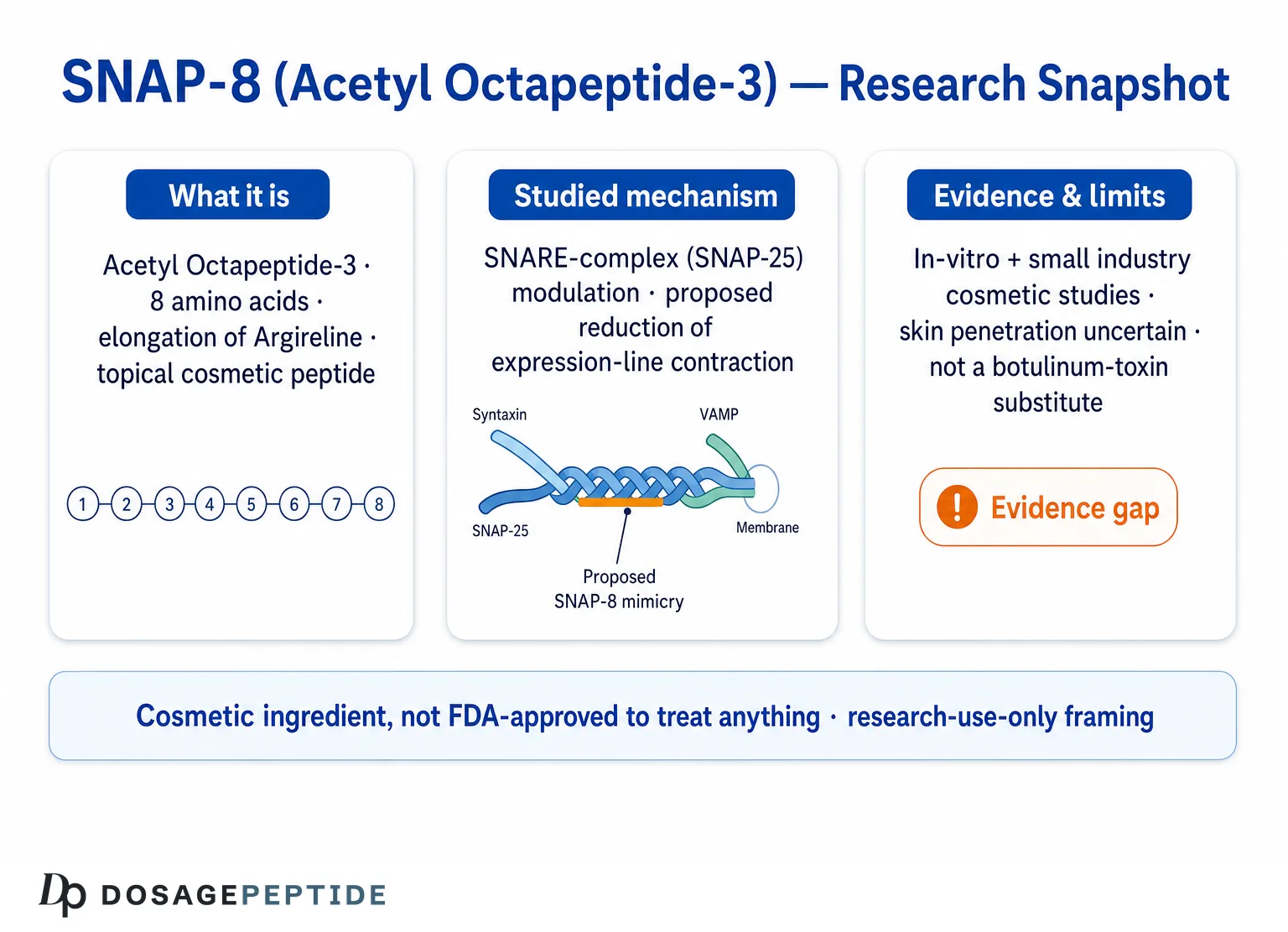
Short answer: SNAP-8 (INCI name acetyl octapeptide-3) is a cosmetic peptide designed to imitate a fragment of the SNAP-25 protein and blunt the nerve signal that makes expression muscles contract. That mechanism has been demonstrated in cell and biochemical models — not in skin. The wrinkle-reduction percentages quoted all over the internet come almost entirely from manufacturer studies using surrogate endpoints, and the unresolved problem underneath all of them is whether an eight-amino-acid peptide applied to intact skin reaches its target at all.
It is also not Botox, and the comparison is misleading in a specific way: botulinum toxin is injected into the muscle, while SNAP-8 has to cross the stratum corneum and travel to a neuromuscular junction it was never shown to reach. What follows is what the published evidence supports, what it does not, how SNAP-8 relates to Argireline, why the delivery question matters more than the mechanism, and what a study that actually settled the question would need to look like. For how the peptide is handled in research settings, see the SNAP-8 reference page. Research use only; this is not medical or cosmetic advice.
SNAP-8 — sold under the International Nomenclature of Cosmetic Ingredients (INCI) name Acetyl Octapeptide-3 — is one of the most widely marketed “topical Botox alternative” peptides in the cosmetic industry, promoted for softening expression lines around the eyes and forehead. The central research question this reference page examines is narrow and specific: does an eight-amino-acid peptide, applied to the surface of intact skin, plausibly reach the neuromuscular junction and modulate the SNARE complex the way its marketing implies — and what does the actual published evidence, as opposed to manufacturer literature, allow us to say? This article treats SNAP-8 strictly as a cosmetic-ingredient research topic, not a drug, and separates the mechanistic hypothesis from the evidence that has (and has not) been generated to test it.
What Is SNAP-8, and Where Did It Come From? (Research Context)
SNAP-8 is a synthetic peptide belonging to the family of so-called “neurotransmitter-inhibiting” or “neuromodulating” cosmetic peptides. In the standard four-category classification used across the cosmetic-peptide literature — signal peptides, carrier peptides, enzyme-inhibitor peptides, and neurotransmitter-inhibitor peptides — SNAP-8 sits firmly in the last group, alongside its shorter and better-known relative, acetyl hexapeptide-8 (Argireline).[1] The name itself is a marketing contraction: “SNAP” references SNAP-25 (synaptosomal-associated protein of 25 kDa), the protein the peptide is designed to imitate, and “8” denotes its eight residues.
The peptide was developed as an elongation of the earlier acetyl hexapeptide, which was first described around the turn of the millennium as a topical agent patterned on the N-terminal sequence of SNAP-25 and proposed to interfere with neurotransmitter vesicle docking.[2] SNAP-8 was positioned commercially as a “next-generation” or “stronger” version, on the reasoning that a longer peptide segment more faithfully reproduces the relevant stretch of SNAP-25 and therefore competes more effectively for a place in the SNARE assembly. It is important to state at the outset that this “stronger” positioning is a manufacturer hypothesis; there is no head-to-head peer-reviewed clinical trial in the public literature that establishes SNAP-8 as superior to acetyl hexapeptide-8 in intact human skin.
For readers new to the terminology used throughout this page — SNARE, exocytosis, stratum corneum, INCI, and related terms — the peptide research glossary provides concise definitions that make the mechanistic sections easier to follow.
The development lineage: from an injectable-toxin mechanism to a topical mimic
The intellectual origin of this peptide class is a deliberate attempt to reproduce, in a small synthetic molecule, the biological endpoint of botulinum toxin — reduced neuromuscular signaling — without the toxin, the needle, or the prescription. Rather than destroy SNAP-25 the way the toxin does, the designers reasoned, one might synthesize a fragment resembling the reactive N-terminal portion of SNAP-25 and let that fragment compete for a slot in the assembling SNARE complex. The acetyl hexapeptide came first; SNAP-8 (acetyl octapeptide-3) followed as a lengthened variant built on the same premise. It is worth noting that the peptide has been produced and studied by specialist peptide manufacturers rather than by drug developers pursuing an approval pathway — the collaborator on the U.S. neuromuscular trials of the hexapeptide, for instance, was a peptide-manufacturing company.[10] That commercial-and-cosmetic, rather than pharmaceutical, development history is one reason the independent clinical literature is comparatively sparse.
Why the “topical botulinum-toxin alternative” framing is a research question, not a fact
Much consumer-facing copy describes SNAP-8 as a “botulinum-toxin alternative” or “needle-free Botox.” That phrasing conflates a mechanistic analogy with a demonstrated equivalence. Botulinum toxin type A is an injectable prescription biologic that enzymatically destroys SNAP-25 inside the nerve terminal; SNAP-8 is a topically applied cosmetic peptide proposed to interfere with SNARE assembly from a completely different angle and at a completely different potency scale. Treating the two as interchangeable is precisely the overstatement this article is written to unpack. The honest research framing is: SNAP-8 is a cosmetic ingredient whose proposed mechanism is inspired by botulinum pharmacology, and whose real-world efficacy on intact skin remains an open and under-tested question.[3]
How Is SNAP-8 Structurally Related to Argireline and SNAP-25?
To understand SNAP-8, it helps to understand SNAP-25 and the peptide it was cloned from. SNAP-25 is a core member of the SNARE protein family that drives the fusion of neurotransmitter-containing vesicles with the presynaptic membrane. During exocytosis, SNAP-25 (a target-membrane, or “t-SNARE,” protein) zippers together with syntaxin-1 and the vesicle protein synaptobrevin/VAMP to form the ternary SNARE complex — the molecular machine that pulls the vesicle and plasma membranes close enough to fuse and release neurotransmitter.[4]
Argireline (acetyl hexapeptide-8, historically also labeled acetyl hexapeptide-3) is a six-residue peptide, N-acetylated and C-amidated, whose sequence — Ac-Glu-Glu-Met-Gln-Arg-Arg-NH2 — is patterned on the N-terminal end of SNAP-25.[2] Its molecular weight is roughly 889 daltons. SNAP-8, as acetyl octapeptide-3, extends this concept to eight residues by appending two additional amino acids to the same core motif (the commonly reported sequence is Ac-Glu-Glu-Met-Gln-Arg-Arg-Ala-Asp-NH2). The logic is that a longer peptide reproduces a larger portion of the SNAP-25 N-terminal region that participates in SNARE zippering, and so should compete more avidly with native SNAP-25 for incorporation into the ternary complex. Because it is longer, SNAP-8 is also heavier — its molecular weight is approximately 1,073 daltons (about 1.07 kDa, i.e. roughly 1 kDa).
Why the extra weight matters
That increase in size is a double-edged detail. Mechanistically, more of the SNAP-25 sequence may mean a better decoy. Pharmaceutically, more mass means an even harder time crossing the skin barrier — a tension explored in detail in the skin-penetration section below. Both Argireline (~889 Da) and SNAP-8 (~1.07 kDa) sit well above the commonly cited ~500-dalton threshold above which passive percutaneous absorption of a molecule through intact stratum corneum becomes markedly less likely.[5] In other words, the very elongation that is marketed as making SNAP-8 “more potent” also, on first principles, makes delivery to a living muscle harder, not easier. The two extra residues appended to SNAP-8 are themselves a charged, polar addition (an alanine and an aspartate), which does nothing to improve the peptide’s already unfavorable partitioning into the lipid-rich barrier and, if anything, further increases its hydrophilicity.
How Does SNAP-8 Work? The SNARE-Complex Hypothesis (Mechanisms Studied)
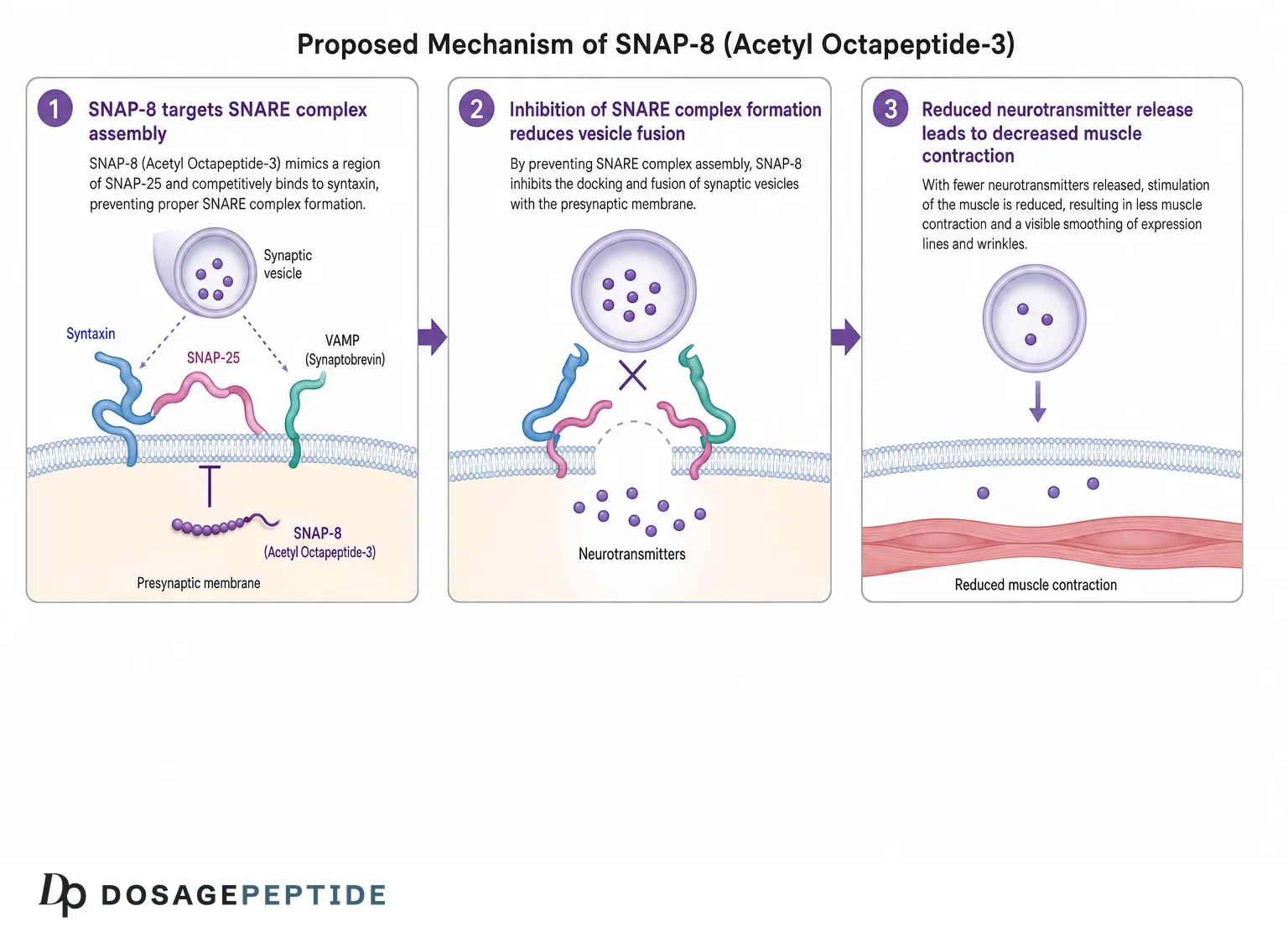
The proposed mechanism of SNAP-8 is a molecular-mimicry, or competitive-decoy, model. Under this model, the peptide imitates the N-terminal segment of SNAP-25 and inserts itself into the forming SNARE complex in place of the genuine protein. A SNARE complex that contains the short peptide decoy instead of intact SNAP-25 is proposed to be destabilized or non-functional, so vesicle docking and calcium-triggered fusion are less efficient. The downstream consequence, in the mechanistic hypothesis, is reduced release of neurotransmitters (acetylcholine at the neuromuscular junction, and catecholamines in adrenergic contexts) and, ultimately, subtly weaker or less frequent contraction of the small facial muscles responsible for dynamic “expression lines.”[3]
Each link in that chain has an anchor in genuine synaptic biology, which is part of why the story is persuasive. The SNARE complex is genuinely the fusion engine of exocytosis. In the accepted model of fast neurotransmitter release, a vesicle is first docked and primed at the active zone; the three SNARE proteins (SNAP-25, syntaxin-1, and synaptobrevin/VAMP) begin to zipper into a tight four-helix bundle that forces the two membranes together; and when an action potential admits calcium into the terminal, the calcium sensor synaptotagmin binds this core fusion machinery to trigger the final fusion step in well under a millisecond, while complexin adaptor proteins first clamp and then help activate the primed complex, and RIM-containing scaffolds position the primed vesicles next to the calcium channels that feed them.[4] SNAP-25 is therefore not a peripheral participant but one of the three load-bearing helices of that bundle, which is exactly why interfering with it — whether by enzymatic cleavage or, hypothetically, by a competing decoy fragment — would be expected to blunt release. The C-terminal coil of SNAP-25 is genuinely required at the final calcium-triggered step of release: in classic PC12-cell experiments, a recombinant SNAP-25 C-terminal peptide could rescue neurotransmitter release that had been blocked by botulinum neurotoxin E, demonstrating that short SNAP-25-derived peptides can physically engage the fusion machinery in a cell-free/permeabilized system.[6] And SNAP-25 abundance genuinely governs synaptic output. In a striking demonstration in zebrafish, overexpressing a microRNA (miR-153) that targets SNAP-25 drove the protein down and produced near-complete paralysis that the authors explicitly compared to the effect of botulinum neurotoxin, whereas loss of that same microRNA raised SNAP-25 levels and caused hyperactive movement.[7] That dose-dependent relationship — less functional SNAP-25 means less neurotransmission — is the biological principle a decoy peptide is trying to exploit. The gap between this principle and a topical cosmetic is not the principle itself but whether a surface-applied peptide can lower the pool of functional SNAP-25 at a human facial junction to any measurable degree.
The stoichiometry problem inherent to a decoy mechanism
There is a further, often-overlooked conceptual point about any competitive-decoy mechanism. A decoy is not a catalyst: one decoy molecule can occupy at most one SNARE assembly site, so to meaningfully out-compete native SNAP-25 the peptide would need to be present at the assembly site in substantial, near-stoichiometric quantities relative to the endogenous protein. This is fundamentally different from botulinum toxin, whose enzymatic light chain can inactivate many SNAP-25 molecules in succession. The absence of catalytic amplification means that even a peptide that engages the machinery efficiently in a test tube would need to arrive at the neuromuscular junction in relatively large amounts to shift the balance — which places an even heavier burden on the delivery step discussed below.
The critical caveat: mechanism was demonstrated in cell and biochemical models, not in skin
What those experiments establish is that SNAP-25-derived sequences can interfere with the fusion machinery when they are placed directly among the SNARE proteins — in permeabilized cells, synaptosome preparations, or in-vitro assays. What they do not establish is that a topically applied octapeptide crosses the stratum corneum, the epidermis, and the dermis, reaches a neuromuscular junction in a living human face at a meaningful concentration, and there produces the same interference. The mechanistic evidence and the delivery evidence are two separate problems, and the peptide-cosmetics literature is explicit that the second one — whether the molecule actually reaches its target after topical application — remains incompletely resolved.[3] This is the single most important honesty point about SNAP-8: a plausible and partly demonstrated molecular mechanism is not the same thing as a demonstrated topical effect on facial muscle.
How Does SNAP-8 Differ From Botulinum Toxin?
The comparison with botulinum toxin is unavoidable because SNAP-8 is deliberately marketed against it, but the two agents differ on nearly every axis that matters — molecule type, mechanism, potency, route, regulatory status, and evidence base. Understanding those differences is the fastest way to calibrate realistic expectations.
Botulinum neurotoxin type A is a ~150 kDa bacterial protein produced by Clostridium botulinum. Its mechanism is enzymatic and intracellular: the toxin binds presynaptic nerve terminals, is internalized by endocytosis, translocates its catalytic light chain into the cytosol, and there acts as a zinc-dependent protease that selectively cleaves SNAP-25 near its C-terminus, disabling those SNAP-25 molecules until the nerve terminal synthesizes new protein.[8] The multi-step intoxication pathway — receptor binding, endocytic uptake, membrane translocation, catalytic cleavage — is precisely why the toxin is so extraordinarily potent, and why it must be injected in minute, carefully dosed amounts by trained clinicians.[9]
The toxin’s selectivity is itself instructive. Botulinum neurotoxin type A cleaves SNAP-25 specifically, whereas botulinum neurotoxin type B and tetanus toxin instead cleave the vesicle protein synaptobrevin/VAMP; each is a zinc-dependent protease that severs one designated SNARE component near a defined bond.[8] This precision, combined with the toxin’s catalytic turnover and active delivery into the terminal, is why these are among the most poisonous substances known, with lethal doses in the nanogram-per-kilogram range in animal models.[9] A topical decoy peptide shares the target — SNAP-25 — but none of these amplifying properties.
SNAP-8, by contrast, is a ~1 kDa cosmetic peptide with a proposed non-enzymatic, competitive mechanism that does not destroy SNAP-25 but merely (in the hypothesis) competes with it. It is applied to the skin surface, not injected. It is regulated as a cosmetic ingredient, not as a drug. And where botulinum toxin type A’s SNAP-25 cleavage mechanism is established by decades of rigorous molecular and clinical science, SNAP-8’s topical efficacy rests largely on manufacturer studies and small cosmetic evaluations.
| Attribute | SNAP-8 (Acetyl Octapeptide-3) | Botulinum toxin type A |
|---|---|---|
| Molecule type | Synthetic 8-residue peptide (~1.07 kDa) | Bacterial protein neurotoxin (~150 kDa) |
| Regulatory class | Cosmetic ingredient (INCI: Acetyl Octapeptide-3) | FDA-approved prescription drug (e.g., glabellar lines, and several medical indications) |
| Route | Topical, applied to skin surface | Intramuscular injection by a clinician |
| Target | SNAP-25 / SNARE assembly (proposed competitive mimicry) | SNAP-25 (enzymatic cleavage of the C-terminus) |
| Mechanism | Non-enzymatic decoy; does not destroy SNAP-25 (hypothesis) | Zinc-protease that catalytically cleaves SNAP-25[8] |
| Reaches nerve terminal? | Uncertain after topical use; skin penetration is a key open question[3] | Yes — receptor-mediated uptake into the terminal[9] |
| Relative potency | Far weaker; subtle cosmetic effect at best | Extremely potent at picomolar–nanomolar quantities |
| Duration | Requires continued daily application | Weeks to months per treatment |
| Evidence base | Manufacturer/in-vitro data + small cosmetic studies | Extensive controlled clinical trials + molecular science |
The comparison also clarifies why “topical Botox” is a category error rather than a like-for-like substitution. Botulinum toxin works because it is a catalyst: one toxin molecule can cleave many SNAP-25 molecules, and it is actively transported into the very compartment where SNAP-25 lives. A competitive decoy peptide has no such catalytic amplification — as noted above, it would need to be present in large stoichiometric amounts at the SNARE assembly site to matter, which makes the delivery bottleneck all the more decisive.
What Does the Current Evidence Show? (Current Evidence Level)
Here it is essential to grade the evidence precisely rather than lumping it together. For SNAP-8 specifically, the publicly available, independently peer-reviewed clinical evidence is thin. Most efficacy claims trace back to manufacturer or ingredient-supplier studies and in-vitro assays, supplemented by small cosmetic evaluations that measure surrogate endpoints such as instrumented wrinkle depth, roughness parameters from silicone skin replicas, elasticity, and hydration. These are legitimate cosmetic-science endpoints, but they are not the same as adequately powered, independent, placebo-controlled drug trials, and they generally do not directly demonstrate reduced muscle contraction.[3]
The most instructive published clinical data actually come from SNAP-8’s shorter relative, acetyl hexapeptide-8. In a randomized, placebo-controlled study in 60 Chinese subjects (randomized 3:1 to peptide or placebo), twice-daily topical Argireline over four weeks produced statistically significant reductions in objectively measured peri-orbital roughness parameters (p<0.01) relative to placebo, with a subjective anti-wrinkle response rate reported at 48.9% versus 0% in the placebo arm.[2] That is real, peer-reviewed, hypothesis-supporting evidence — but it is for the hexapeptide, in a single modestly sized study, using surface-topography surrogates rather than neuromuscular measurements, and it should not simply be assumed to transfer to the heavier octapeptide.
What the neuromuscular-disorder trials of the related peptide reveal
An underappreciated and honestly sobering data point comes from clinical trials of topical acetyl hexapeptide-8 conducted not for cosmetics but for a genuine neuromuscular condition. The U.S. National Institute of Neurological Disorders and Stroke registered and ran investigational trials of topical acetyl hexapeptide-8 for benign essential blepharospasm — a focal dystonia of involuntary eyelid muscle contraction. One early-phase study (24 participants) was completed[10] and a subsequent placebo-controlled, double-blind phase-2 study of the same topical peptide, testing higher concentrations, was ultimately terminated with only 8 participants enrolled.[11] The very existence of these trials shows the neuromuscular hypothesis was taken seriously enough to test formally; the fact that this line of investigational development did not yield an approved neuromuscular therapy underscores how far a plausible mechanism can sit from a proven clinical effect. For a cosmetic ingredient claiming a neuromuscular mode of action, that gap is the whole story.
How to read cosmetic efficacy studies critically
When appraising any SNAP-8 study, several questions separate signal from marketing: Was it independent of the ingredient supplier? Was it randomized and placebo/vehicle-controlled? Was the outcome an instrumented, blinded measurement or an unblinded impression? Was the “placebo” a true vehicle-matched control, given that a well-formulated moisturizing base alone improves the appearance of fine lines by hydrating and plumping the stratum corneum? Many peptide-cosmetic results are consistent with a genuine but modest ingredient effect layered on top of a substantial vehicle/hydration effect, and the literature repeatedly flags that the precise contribution of the peptide — versus the formulation carrying it — is hard to isolate.[1] A further complication is that the actual peptide content of finished consumer products is often neither disclosed nor standardized, so two serums bearing the same INCI name can differ by orders of magnitude in how much active they contain — a point underscored by regulatory-review findings that some marketed products contained far higher peptide concentrations than ingredient-use surveys had assumed.[14]
What the endpoints actually measure — and what they do not
It is worth being concrete about what cosmetic efficacy studies of these peptides record, because the choice of endpoint quietly sets the ceiling on what a positive result can mean. The peer-reviewed Argireline study, for example, combined a subjective global assessment using established wrinkle-grading classifications with an objective method in which silicone replicas of the peri-orbital skin were cast before and after treatment and then analyzed by a wrinkle-analysis apparatus that quantifies surface roughness parameters.[2] This kind of surface profilometry, along with instruments that measure skin hydration (corneometry) and elasticity (cutometry), makes up the standard cosmetic-science toolkit, and it is genuinely quantitative. But every one of these endpoints measures a property of the skin surface or dermis — how rough, how hydrated, how elastic the skin is — and none of them directly measures muscle activity, motor-nerve firing, or the state of SNAP-25 at a neuromuscular junction. A reduction in measured roughness is therefore fully compatible with the peptide never having reached a muscle at all: hydration, plumping, and the smoothing effect of the vehicle can move these numbers on their own. The endpoints validate that the appearance of the skin can change; they do not, by construction, validate the neuromuscular mechanism that the marketing invokes.
The related review reinforces how much remains unproven at the mechanistic level: even as preclinical and clinical work suggests acetyl hexapeptide-8 may reduce wrinkle depth and improve elasticity and hydration — and may have additional effects such as scar remodeling and sebum regulation — the precise biological basis of these effects, and in particular the peptide’s ability to inhibit muscle contraction when applied topically, is described as incompletely understood.[3] For SNAP-8, which has less independent data than the hexapeptide, the same caution applies with an even wider margin of uncertainty.
The Skin-Penetration Problem: Can an 8-mer Even Reach Its Target?
If there is one scientific issue that determines whether SNAP-8 can work as advertised, it is percutaneous delivery. The stratum corneum — the outermost, densely keratinized, lipid-rich layer of the epidermis — is an exceptionally effective barrier, and it is selective by molecular size. It is often described with a “brick-and-mortar” analogy: flattened, protein-filled dead cells (corneocytes) are the bricks, embedded in a mortar of tightly organized intercellular lipid lamellae. To cross it passively, a molecule generally has to partition into and diffuse through that lipid mortar, which favors small, reasonably lipophilic compounds and penalizes large, water-loving, charged ones. The widely cited “500 dalton rule” distills this into a single heuristic: virtually all common contact allergens, essentially all topical drugs used in dermatology, and all actives delivered by transdermal patches fall under about 500 daltons, and molecules much larger than this generally cannot traverse intact stratum corneum by passive diffusion.[5] The rule is a generalization rather than a hard cutoff, but it captures a real physical constraint. SNAP-8, at roughly 1.07 kDa, is about twice that threshold. It is also highly hydrophilic and carries charged residues (including the acidic glutamate and aspartate side chains and the basic arginines), which further disfavors partitioning into the lipophilic barrier.
This is not a fringe objection; it is the central theme of the dedicated peer-reviewed review of acetyl hexapeptide-8’s permeability and efficacy, which concludes that the peptide’s hydrophilic nature and relatively large size make effective dermal delivery challenging and that its ability actually to reach neuromuscular junctions after topical application “remains uncertain.”[3] Since SNAP-8 is larger still, the same objection applies with greater force. Any measured surface improvement in wrinkle appearance therefore raises an unresolved question: is it because a fraction of peptide reached and modulated muscle, or because the formulation improved the skin surface by other means entirely?
Why depth of delivery, not just crossing, is the issue
Even the phrase “does it penetrate?” understates the problem. To act on its proposed target, SNAP-8 would need not merely to cross the stratum corneum but to reach the level of facial muscle and the neuromuscular junctions embedded there — a far deeper destination than the epidermis or superficial dermis where most topically delivered actives accumulate. The facial muscles that create expression lines (such as orbicularis oculi and the frontalis) are separated from a topically applied serum by the full thickness of the epidermis and dermis, so even a molecule that gets past the outermost barrier still has a long way to travel before it could plausibly engage a motor nerve terminal. The broader cosmetic-peptide literature acknowledges that poor permeability across membranes is the single most significant drawback of this entire class of ingredients, which is exactly why so much research energy goes into delivery-enhancement strategies rather than the peptides themselves.[1]
How Is SNAP-8 Formulated and Studied to Improve Delivery?
Because raw peptide on skin faces such a steep barrier, most serious SNAP-8 research is really formulation research. Investigators have explored a range of vehicle and enhancement strategies to nudge more peptide past the stratum corneum: oil-in-water and multiple water-in-oil-in-water emulsions, penetration enhancers, and encapsulation in nano-carriers.[3] The general cosmetic-peptide field extends this toolbox to liposomes, niosomes, ethosomes, nanoemulsions, and physical methods such as microneedling, iontophoresis, electroporation, and fractional-laser or radiofrequency pre-treatment — all aimed at overcoming the same permeability ceiling.[1]
These strategies fall into two broad families, and the distinction matters for how much a laboratory result tells us about a jar of serum. Chemical and formulation approaches try to change how the peptide is presented to the skin — trapping it in liposomes, niosomes, or ethosomes; dispersing it in nanoemulsions; or adding penetration enhancers that transiently loosen the lipid mortar. Physical approaches instead bypass or breach the barrier: microneedling creates transient micro-channels through the stratum corneum, iontophoresis uses a small electric current to drive charged molecules inward, electroporation applies brief pulses to open transient pores, and ablative methods such as fractional laser, radiofrequency, or ultrasound disrupt the outer layer to let larger actives through.[1] The physical methods can be genuinely effective, but they are procedures, not ingredients; a peptide that only works when driven in by a needle array or an electric field is telling on itself, because a conventional leave-on cosmetic offers none of that assistance.
The logic of these approaches is well illustrated by adjacent research. Deep-eutectic-solvent permeation enhancers have been shown, in laboratory skin models, to increase transdermal delivery of a peptide that otherwise permeates poorly, improving its bioactivity readouts.[12] Likewise, work on fusing bioactive proteins to cell-penetrating peptides is an explicit attempt to engineer transdermal capability into molecules that lack it natively.[13] The takeaway is telling: the field’s heavy investment in delivery engineering is itself an admission that unaided topical peptides — SNAP-8 included — do not reliably reach their targets. It also means that a result obtained with a sophisticated enhanced vehicle in a laboratory skin model cannot be assumed to hold for an off-the-shelf serum applied to a consumer’s face.
Readers interested in how reconstitution and formulation variables are handled in peptide research more broadly can consult the peptide reconstitution guide, which explains concentration and handling concepts relevant to any research peptide, and the structured SNAP-8 research reference protocol, which compiles the ingredient’s reported specifications in one place for reference purposes only.
What Is Known About the Safety and Tolerability of SNAP-8?
As a topically applied cosmetic ingredient at the low concentrations used in finished products, SNAP-8 is generally regarded within cosmetic practice as well tolerated, with irritation and allergic contact reactions being the principal reported concerns for peptide cosmetics as a class. Two honest qualifications belong alongside that statement. First, an apparent absence of dramatic adverse effects is partly a corollary of the same limited-penetration problem discussed above: a molecule that struggles to reach living tissue also has limited opportunity to cause systemic harm, so a benign topical safety profile is not evidence of efficacy. Second, the peptide-cosmetic literature notes that potential allergic reactions and the need for standardized safety and regulatory evaluation remain live issues for the field, and that long-term controlled safety data specific to individual neuromodulating peptides are limited.[1]
The most formal safety review in this area concerns the closely related acetyl hexapeptide-8 rather than SNAP-8 itself. A Cosmetic Ingredient Review (CIR) Expert Panel assessment concluded that acetyl hexapeptide-8 (and its amide) is safe as used in cosmetics at the low concentrations reported in ingredient-use surveys (on the order of up to 0.005% for leave-on products), while explicitly stating that the available data were insufficient to conclude safety at higher concentrations.[14] That nuance is important: a “safe as used” conclusion is bounded by the concentrations that were actually surveyed, and it applies to the hexapeptide, not automatically to the heavier octapeptide, for which no comparably rigorous independent safety assessment is publicly established.
A separate consideration is formulation stability rather than acute safety. Studies of the related acetyl hexapeptide have detected chemical changes such as oxidation of the methionine residue in cosmetic formulations, and the biological consequences of such oxidized species are not fully characterized.[3] This matters because a peptide’s identity on an ingredient label does not guarantee its chemical integrity in the jar over a product’s shelf life — another reason claims should be tempered. Because both Argireline and SNAP-8 contain a methionine at the same position, the same oxidative-degradation concern applies in principle to the octapeptide.
What Is the Regulatory Status of SNAP-8?
SNAP-8 is a cosmetic ingredient. Under the INCI system it is listed as Acetyl Octapeptide-3, and it is used in leave-on cosmetic products marketed for the appearance of the skin. It is not an FDA-approved drug, it is not approved to treat, cure, or prevent any disease or condition, and it is not approved as a therapeutic alternative to botulinum toxin. In the United States, a cosmetic is defined by its intended use in cleansing or beautifying and altering appearance, whereas a product intended to affect the structure or function of the body — which is exactly what a claim to relax facial muscles implies — edges into drug territory and a different, far more demanding evidentiary and approval standard. This is why compliant marketing tends to speak of the “appearance” of expression lines rather than making an explicit muscle-paralysis claim.
This cosmetic-versus-drug boundary is not unique to the United States. Across major regulatory frameworks, a product that merely improves the appearance of skin is treated as a cosmetic, while a product that claims to alter a physiological structure or function — here, to weaken a muscle — is held to a drug-level standard of evidence and approval. Acetyl Octapeptide-3 is handled as a cosmetic ingredient in these systems, which is precisely why responsible labeling confines itself to appearance-based language. The practical consequence for anyone reading marketing copy is simple: the more a product’s messaging leans on an explicit neuromuscular or “muscle-relaxing” mechanism, the more it is making a claim its regulatory category was never required to substantiate.
The contrast with botulinum toxin is again clarifying: botulinum toxin type A products are licensed prescription biologics with defined indications, dosing, and safety monitoring, precisely because they are potent structure-and-function agents. SNAP-8 occupies the opposite end of the regulatory spectrum. Presenting it as a functional stand-in for an injectable drug is not just scientifically premature; it also blurs a regulatory line that exists to protect consumers. Nothing in this article should be read as endorsing any structure-or-function or therapeutic use of SNAP-8.
What Are the Main Limitations of the SNAP-8 Evidence Base?
Pulling the threads together, several concrete limitations define what can and cannot be claimed about SNAP-8 today.
1. The delivery gap is unresolved
The most fundamental limitation is that it has not been convincingly demonstrated that topically applied SNAP-8 reaches facial neuromuscular junctions at concentrations sufficient to modulate SNARE assembly in living human skin. Molecular weight (~1.07 kDa), hydrophilicity, and charge all work against passive penetration, and the dedicated permeability review characterizes target engagement after topical use as uncertain.[3]
2. Mechanism is inferred from non-skin models
The evidence that SNAP-25-derived peptides can perturb the fusion machinery comes from biochemical and cell-based systems where the peptide is placed directly among the SNARE proteins, not from intact skin.[6] Extrapolating from a permeabilized-cell rescue assay to a consumer’s forehead is a large inferential leap.
3. Efficacy data are limited, largely industry-sourced, and surrogate-based
Clinical evidence is dominated by manufacturer studies and small evaluations using surface-topography and elasticity surrogates rather than direct neuromuscular endpoints, and much of the strongest peer-reviewed clinical data is for the hexapeptide relative, not SNAP-8 itself.[2] Independent, adequately powered, vehicle-controlled trials of SNAP-8 specifically are scarce.
4. The vehicle-effect confound
Because moisturizing bases independently improve the appearance of fine lines, and because peptide effects are modest, isolating the peptide’s specific contribution is genuinely difficult — a confound the cosmetic-peptide literature explicitly acknowledges.[1]
5. Formulation and stability variability
Results obtained with optimized delivery vehicles or fresh peptide may not generalize to ordinary consumer products, and chemical changes such as methionine oxidation during storage introduce further uncertainty about what is actually on the skin.[3]
What would it take to actually settle the question?
Framing the gaps as a research agenda makes the current uncertainty concrete. A convincing case for SNAP-8’s advertised mechanism would need, at minimum, three things that the present literature does not supply. First, direct delivery evidence: quantitative measurement, in intact human skin, of how much intact peptide actually reaches the depth of a facial neuromuscular junction after realistic topical dosing — not merely detection in the superficial epidermis. Second, mechanism-specific endpoints: a demonstration that any wrinkle improvement tracks with reduced muscle activity (for instance by electromyography or a validated dynamic-wrinkle measure) rather than with hydration or surface smoothing alone. Third, independent, adequately powered, vehicle-controlled, blinded trials of SNAP-8 itself — not the hexapeptide, and not studies funded and conducted solely by the ingredient supplier — with pre-registered outcomes. Until those pieces exist, the honest scientific position is not that SNAP-8 has been disproven, but that its central claim remains untested at the level that would be required to accept it. That is a very different statement from “it works like topical Botox.”
Collectively these limitations justify a cautious, research-framed reading: SNAP-8 is a biologically motivated cosmetic ingredient with a plausible mechanism and some supportive surrogate data, whose real-world topical efficacy and target engagement remain open scientific questions rather than settled facts.
How Does SNAP-8 Fit Among Other Skin-Research Peptides?
SNAP-8 is only one entry in a large and heterogeneous peptide-cosmetics landscape, and comparing categories helps set expectations. Neurotransmitter-inhibitor peptides like SNAP-8 and Argireline aim at the dynamic, muscle-driven component of expression lines. Signal peptides, by contrast, are proposed to stimulate matrix synthesis such as collagen. Carrier peptides are designed to deliver trace elements involved in repair — the copper-carrying tripeptide GHK-Cu being the archetype, discussed in detail in the GHK-Cu research overview. Anti-inflammatory peptides address the inflammatory contribution to skin aging and barrier disruption, exemplified by the tripeptide covered in the KPV research overview.[1]
This four-way classification — signal, carrier, enzyme-inhibitor, and neurotransmitter-inhibitor peptides — is the organizing scheme used across the cosmetic-peptide reviews, and it is useful precisely because it maps each peptide to a different biological target and therefore a different plausibility profile.[1] Enzyme-inhibitor peptides act on extracellular enzymes such as matrix metalloproteinases at or near the skin surface; signal peptides act on fibroblasts in the dermis; carrier peptides ferry a bound cofactor into the tissue. All of these targets are, in delivery terms, comparatively shallow. The neurotransmitter-inhibitor subclass to which SNAP-8 belongs is the outlier, because its nominal target — the motor nerve terminal at the muscle — sits deeper than any of the others and behind the same barrier that limits the whole class. That structural fact, more than any single study, is why claims for topical neuromodulators warrant the most scrutiny within an already cautiously evaluated ingredient category.
Seen in this context, SNAP-8’s distinctive feature — and its distinctive vulnerability — is its dependence on reaching a deep neuromuscular target. A signal or carrier peptide that acts on fibroblasts or the superficial dermis has a shorter delivery journey than a neuromodulator that must reach muscle; other things equal, the shorter the journey, the more plausible the topical effect. This is a useful lens for evaluating any “topical botulinum-toxin alternative” claim: the more the proposed mechanism depends on depth of delivery, the more skeptical one should be of a passive topical formulation.
Frequently Asked Questions
Is SNAP-8 the same thing as Botox?
No. Botox is an injectable prescription drug — botulinum toxin type A, a ~150 kDa bacterial protein that enzymatically cleaves SNAP-25 inside nerve terminals.[8] SNAP-8 is a ~1 kDa topical cosmetic peptide with a proposed competitive-decoy mechanism that does not destroy SNAP-25. They differ in size, potency, route, regulation, and evidence. Describing SNAP-8 as “topical Botox” is a marketing analogy, not a scientific equivalence.
Does SNAP-8 actually reduce wrinkles?
Some small and largely industry-sourced cosmetic studies report modest improvements in surrogate measures such as instrumented wrinkle depth, roughness, elasticity, and hydration, and peer-reviewed data exist for its shorter relative Argireline.[2] However, independent, well-controlled clinical evidence for SNAP-8 specifically is limited, and improvements may partly reflect the moisturizing vehicle rather than the peptide itself.
Can an 8-amino-acid peptide penetrate skin to reach muscle?
This is the central open question. At roughly 1.07 kDa, SNAP-8 is well above the ~500-dalton threshold associated with reliable passive skin penetration, and it is hydrophilic and charged.[5] A dedicated review of the related hexapeptide concludes that whether such peptides actually reach neuromuscular junctions after topical use remains uncertain.[3] Reaching muscle is even harder than merely crossing the outer skin layer.
What is the difference between SNAP-8 and Argireline?
Both are neurotransmitter-inhibitor cosmetic peptides patterned on the N-terminus of SNAP-25. Argireline (acetyl hexapeptide-8) has six residues and weighs about 889 daltons; SNAP-8 (acetyl octapeptide-3) has eight residues and weighs roughly 1.07 kDa.[1] SNAP-8 is marketed as an elongated, stronger analogue, but no peer-reviewed head-to-head trial in intact human skin confirms superiority.
What is the SNARE complex, and why does it matter here?
The SNARE complex is the protein machine that fuses neurotransmitter vesicles with the nerve-terminal membrane, enabling neurotransmitter release; SNAP-25 is one of its core components.[4] SNAP-8 is designed to imitate part of SNAP-25 and, in theory, interfere with SNARE assembly, thereby reducing the muscle contractions that create dynamic expression lines — if it can reach the junction.
Is SNAP-8 approved by the FDA?
SNAP-8 is used as a cosmetic ingredient (INCI: Acetyl Octapeptide-3), not as an FDA-approved drug. It is not approved to treat, cure, or prevent any condition, and it is not an approved therapeutic substitute for botulinum toxin. Claims that it relaxes muscles would move it toward drug territory, which carries a far higher evidentiary bar than cosmetics must meet.
Has topical acetyl hexapeptide ever been tested as a real neuromuscular treatment?
Yes, and the outcome is instructive. Investigational trials of topical acetyl hexapeptide-8 for the eyelid-muscle disorder blepharospasm were registered by a U.S. neurological institute; one early study was completed[10] and a later placebo-controlled phase-2 study was terminated with only a handful of participants.[11] The neuromuscular hypothesis was taken seriously enough to test, but this path did not produce an approved neuromuscular therapy.
Why do product formulas emphasize delivery systems so much?
Because unaided topical peptides penetrate skin poorly, most research effort goes into vehicles and enhancement methods — specialized emulsions, liposomes and other nanocarriers, and physical techniques — that try to push more peptide past the barrier.[1] The prominence of delivery engineering is itself an acknowledgment that the peptide alone does not reliably reach its target.
Is SNAP-8 safe to use in cosmetics?
At the low concentrations used in finished products, SNAP-8 is generally considered well tolerated in cosmetic practice, with irritation and allergic contact reactions being the main class concerns; long-term controlled safety data for individual neuromodulating peptides are limited.[1] A formal safety review of the related acetyl hexapeptide-8 found it safe as used at surveyed concentrations, with data insufficient above those levels.[14] A benign topical safety profile partly reflects limited penetration and is not evidence of efficacy. This page is informational only and is not medical or cosmetic-use advice.
References
- Pintea A, Manea A, Pintea C, et al. Peptides: Emerging Candidates for the Prevention and Treatment of Skin Senescence: A Review. Biomolecules. 2025;15(1):88. doi:10.3390/biom15010088
- Wang Y, Wang M, Xiao S, et al. The anti-wrinkle efficacy of argireline, a synthetic hexapeptide, in Chinese subjects: a randomized, placebo-controlled study. Am J Clin Dermatol. 2013;14(2):147–153. doi:10.1007/s40257-013-0009-9
- Zdrada-Nowak J, Surgiel-Gemza A, Szatkowska M. Acetyl Hexapeptide-8 in Cosmeceuticals—A Review of Skin Permeability and Efficacy. Int J Mol Sci. 2025;26(12):5722. doi:10.3390/ijms26125722
- Südhof TC. Neurotransmitter release: the last millisecond in the life of a synaptic vesicle. Neuron. 2013;80(3):675–690. doi:10.1016/j.neuron.2013.10.022
- Bos JD, Meinardi MMHM. The 500 Dalton rule for the skin penetration of chemical compounds and drugs. Exp Dermatol. 2000;9(3):165–169. doi:10.1034/j.1600-0625.2000.009003165.x
- Chen YA, Scales SJ, Duvvuri V, et al. Calcium regulation of exocytosis in PC12 cells. J Biol Chem. 2001;276(28):26680–26687. doi:10.1074/jbc.M103522200
- Wei C, Thatcher EJ, Olena AF, et al. miR-153 regulates SNAP-25, synaptic transmission, and neuronal development. PLoS One. 2013;8(2):e57080. doi:10.1371/journal.pone.0057080
- Blasi J, Chapman ER, Link E, et al. Botulinum neurotoxin A selectively cleaves the synaptic protein SNAP-25. Nature. 1993;365(6442):160–163. doi:10.1038/365160a0
- Pirazzini M, Azarnia Tehran D, Leka O, et al. On the translocation of botulinum and tetanus neurotoxins across the membrane of acidic intracellular compartments. Biochim Biophys Acta. 2015;1858(3):467–474. doi:10.1016/j.bbamem.2015.08.014
- National Institute of Neurological Disorders and Stroke. A Study of Acetyl Hexapeptide-8 (AH8) in Treatment of Blepharospasm. ClinicalTrials.gov identifier NCT00942851 (completed).
- National Institute of Neurological Disorders and Stroke. Placebo Controlled Double Blind Study of Acetyl Hexapeptide-8 in Treatment of Blepharospasm. ClinicalTrials.gov identifier NCT01750346 (terminated).
- Bai D, Wang Z, Xiao Y, et al. Transdermal delivery of elastin peptide assisted by betaine-based deep eutectic solvent to ameliorate skin photoaging. Biomater Adv. 2024;163:213965. doi:10.1016/j.bioadv.2024.213965
- Yu G, Zhao W, Wang Y, Xu N. Molecular farming: expression of recombinant fusion proteins applied to skincare strategies. PeerJ. 2024;12:e17957. doi:10.7717/peerj.17957
- Cosmetic Ingredient Review Expert Panel. Safety Assessment of Acetyl Hexapeptide-8 and Acetyl Hexapeptide-8 Amide as Used in Cosmetics. Washington, DC: Cosmetic Ingredient Review; 2021.
Disclaimer: This article is provided for educational and research-reference purposes only. SNAP-8 (Acetyl Octapeptide-3) is a cosmetic ingredient, not an FDA-approved drug; it is not approved to treat, cure, or prevent any disease or condition, and it is not a therapeutic substitute for botulinum toxin or any medical treatment. Nothing here is medical, cosmetic, or professional advice, nor a recommendation for personal use, self-administration, or dosing. Descriptions of mechanisms and findings refer to in-vitro, animal, formulation, or research-model settings and should not be interpreted as promises of results in humans. Consult a qualified healthcare professional before making decisions related to skin health or any product.