
Dihexa (10 mg) Dosage Protocol
Dihexa (PNB-0408) is an orally studied angiotensin-IV-derived research compound investigated for synaptogenesis in animal models — a preclinical research chemical with zero human trials.
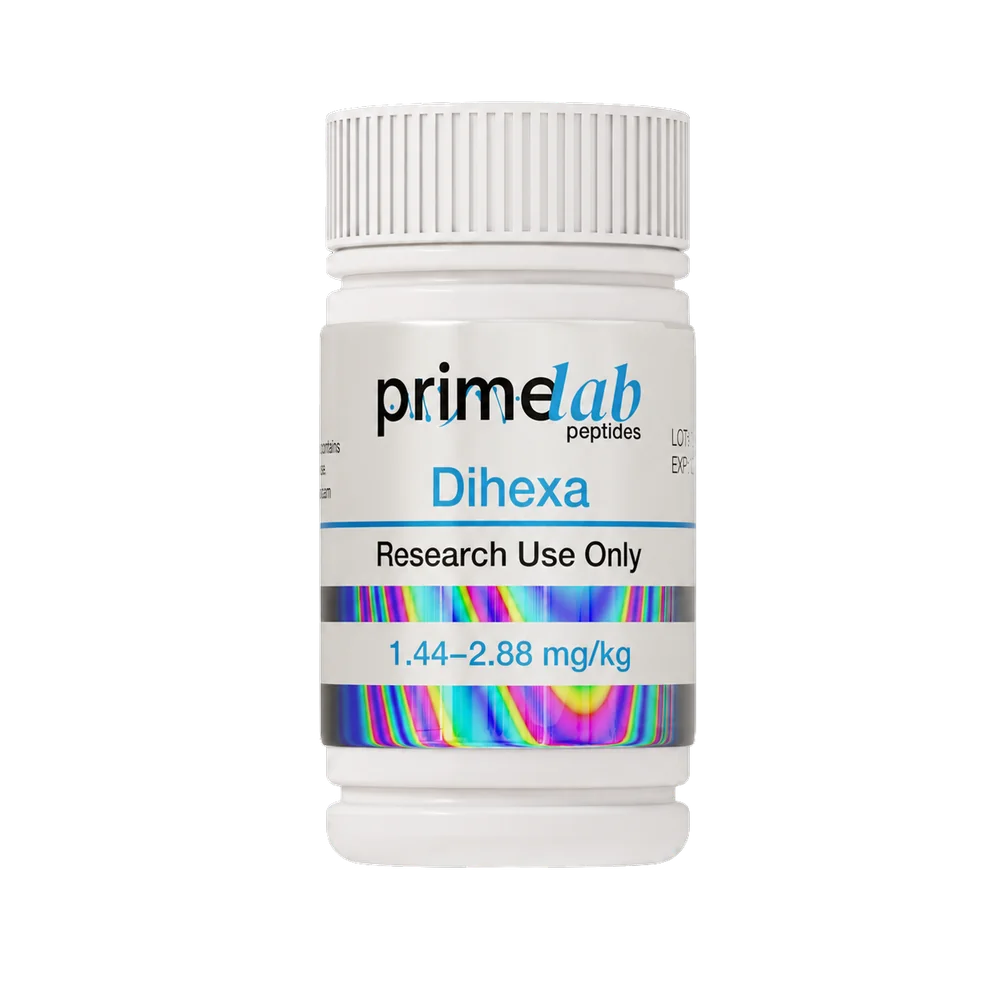
Angiotensin-IV analog reported to engage the hepatocyte growth factor (HGF)/c-Met system and promote dendritic spine formation in animal neurons — key mechanism papers retracted in 2025.
No human dose is established. Documented doses are animal-only: ~1.44-2.88 mg/kg oral in mice. Presented as reference data, not a protocol.
Handled as an oral, sublingual or transdermal preparation in research settings; highly lipophilic and poorly water-soluble. Not reconstituted for injection.
Lyophilized/solid stored cold and desiccated, protected from light; solutions in DMSO/PEG vehicles are short-lived. Not a sterile injectable product.
Quickstart Highlights
Dihexa (also written PNB-0408; N-hexanoic-Tyr-Ile-(6)-aminohexanoic amide, CAS 1401708-83-5) is a small, metabolically stabilized angiotensin IV (AngIV) analog engineered to survive the gut and cross the blood-brain barrier after oral dosing[1]. In the published literature it is studied for cognition and neuroplasticity — specifically for a reported effect on synaptogenesis (dendritic-spine formation) that its designers proposed is mediated through the hepatocyte growth factor (HGF) / c-Met receptor system[5].
That signal is preclinical only: Dihexa has never entered a human clinical trial, several of the foundational mechanism papers were retracted in 2025 for falsified/fabricated data[4], and everything below reflects animal reference data and community conventions provided strictly for research and educational reference — not medical advice or a recommendation to self-administer.
Supplies Needed
Unlike the injectable peptides catalogued elsewhere on this site, Dihexa is strongly lipophilic and poorly water-soluble, so it is not reconstituted with bacteriostatic water into a sterile solution. In documented animal work it was dispersed in a mixed organic vehicle (for example a DMSO / PEG-300 / Tween-80 / saline blend) and dosed by mass[3]. The handling context below reflects that reality.
Protocol Overview
Because Dihexa is dosed by mass rather than reconstituted to a concentration, a 10 mg capsule is simply that mass of solid dispersed in whatever organic vehicle a given protocol specifies — there is no vial-and-water dilution to plan around. How long a pack “lasts” therefore depends entirely on an assumed daily amount that has no validation in people.
Milligram-level solids at these amounts sit near or below the resolution of typical consumer scales, which is one more reason the community’s precision claims should be read skeptically. Any “concentration” quoted for Dihexa depends on the co-solvent system and is not comparable to the aqueous concentrations used elsewhere in this catalog.
Dosing Protocol
An honest map of the only documented dosing data that exists — all of it animal, plus the community ranges and the blank human row. None of it is a human protocol.
| Context | Documented Dose | Notes |
|---|---|---|
| APP/PS1 Alzheimer-model mice (oral) | 1.44 – 2.88 mg/kg | Daily, ~3-month course[3] |
| Scopolamine-impaired rats (oral / systemic) | Low mg/kg range | Water-maze reversal studies[1] |
| Grey-market community ranges | Single-digit to low-double-digit mg/day | Built on vendor vial sizes; not validated in people |
| Human | Not established | Zero human data of any kind |
Why Dihexa draws research interest
These are the directions researchers and the peptide community most often explore Dihexa for — so you know you’re in the right place. They describe what is being studied, not proven benefits, approved uses, or promised results.
Synaptogenesis & dendritic spines
Investigated in rodent tissue and cell models for its reported ability to increase dendritic spine density — preclinical only, and the primary source assays were retracted in 2025.
Memory in dementia models
Studied in scopolamine-impaired rats and APP/PS1 Alzheimer-model mice for effects on spatial memory tasks — animal data, not clinical.
HGF/c-Met neurotrophic signaling
Examined as a small-molecule tool for the hepatocyte growth factor/c-Met pathway, a target explored for neurodegeneration research.
Blood-brain-barrier-penetrant AngIV analog
Studied as a metabolically stabilized, orally active angiotensin-IV derivative designed to reach the brain in animal pharmacokinetic work.
Evidence ranges from early laboratory work to clinical trials depending on the use — the sections below cover the actual data and sources.
No validated human dose. Rodent work used low mg/kg oral; grey-market ranges cite single-digit to low-double-digit mg/day — not anchored to any human data[3].
In animal studies, once daily oral over ~3 months[3]; no human schedule of any kind has been established.
Dosed by mass in a lipid/organic co-solvent — Dihexa is not water-soluble, so no “units-per-mL” or bacteriostatic-water math applies.
Research chemical — preclinical only. Zero human trials; key mechanism papers retracted 2025[4].
Oral Dosing Guide
Because there are no human trials, there is no established human dose, schedule, or validated route for Dihexa. What follows is documented animal reference data plus the ranges that circulate in the grey-market research community — reproduced so readers understand what the literature actually contains, not as instructions and not as a suggestion that any of it be reproduced in people.
Standard / Gradual Approach
There is no titration schedule for Dihexa in humans, because human absorption, metabolism, and the therapeutic window are simply unknown. In peer-reviewed animal work the concrete numbers are oral doses of roughly 1.44–2.88 mg/kg given daily to APP/PS1 Alzheimer-model mice over about three months[3], and low-mg/kg dosing that reversed scopolamine-induced deficits in rodents[1].
A frequent error is to take a mouse figure such as 1.44 mg/kg and multiply by human body weight to “derive” a human dose. Interspecies scaling (for example, body-surface-area conversion) typically reduces a rodent mg/kg figure severalfold, and even a properly scaled number would still be a hypothetical exposure, not a validated dose. This reference deliberately does not publish a converted human number, because doing so would imply a legitimacy that does not exist.
Storage Instructions
The solid/lyophilized material is generally kept cold, dry (desiccated), and protected from light. Because it is not an aqueous solution, the bacteriostatic-water storage windows used for injectable peptides do not apply.
Solutions prepared in organic vehicles (DMSO, PEG, oils) are best regarded as short-lived and non-sterile; DMSO in particular is a potent skin-penetration enhancer that can carry whatever — including contaminants — is dissolved in it, so prepared material should be handled with care and not assumed stable.
Important Notes
Practical framing points that matter more than any number when interpreting what you read about Dihexa.
- ▪Dosed by mass, not by volume: There is no “units-per-mL” or syringe-mark math — a 5 mg or 10 mg quantity is simply that mass of solid in an organic vehicle.
- ▪Animal figures don’t translate by bodyweight: Multiplying a mouse mg/kg dose by human weight is not how interspecies dosing works, and no properly scaled number would be validated anyway.
- ▪c-Met / proliferation concern is real and unresolved: c-Met is the product of the MET proto-oncogene, and aberrant HGF/c-Met signaling drives several cancers; a compound proposed to potentiate c-Met raises a legitimate, uncharacterized theoretical risk of promoting proliferation[5].
- ▪The mechanism is now partly unsupported: Retractions have undermined some of the primary HGF/c-Met synaptogenesis data[4], and the surviving oral-activity characterization paper carries a 2021 Notice of Concern[2].
- ▪Purity is unverifiable at the consumer level: As a grey-market research chemical, material sold as “Dihexa” is not subject to pharmaceutical quality control — identity, purity, and solvent residue are not guaranteed.
How This Works
Dihexa is a modified dipeptide-like molecule built from the tyrosine-isoleucine core of angiotensin IV, with both termini capped by hexanoic-acid-derived groups that raise lipophilicity and blunt enzymatic degradation — the changes that gave it oral activity and blood-brain-barrier penetration[1]. Its designers proposed that it acts as a positive modulator of the HGF/c-Met system, a genuine neurotrophic axis with documented roles in neurite outgrowth and synaptic plasticity[5]. Crucially, the specific papers tying Dihexa to that axis were retracted in 2025 for falsified/fabricated figures, so the mechanism must be treated as unproven pending independent replication[4].
The reported cellular readout is synaptogenesis — increased dendritic-spine density in hippocampal neurons. The famous “~seven orders of magnitude (ten-million-fold) more potent than BDNF” figure comes from a single in-vitro spine-counting assay comparing two molecules that signal through entirely different receptors; it is a relative potency ratio, not a measurement of benefit and not anything measured in a human. Downstream, an independent 2021 study in APP/PS1 mice linked the memory effect to PI3K/AKT signaling, blocked by the inhibitor wortmannin[3] — coherent, but still a mouse result.
Lifestyle Factors
There is no human lifestyle or “stacking” protocol for Dihexa, because there is no human use to build one around. General cognitive-health habits studied on their own merits — sleep, aerobic exercise, and cardiovascular-risk management — have far more human evidence behind them for memory and neuroplasticity than any grey-market compound.
Anyone reading about Dihexa should weigh it against that backdrop: the pharmacology is interesting in animals, but the daily habits with real human data are the ones with an actual track record.
Potential Benefits & Side Effects
What the preclinical literature reports Dihexa is studied for — framed honestly. All of the following is in cells or animals; none is a demonstrated human benefit, and some of the source data has been retracted.
Reported Effects
- ▪Synaptogenesis (in-vitro): Increased dendritic-spine formation in cultured hippocampal neurons — the origin of the “~10-million× BDNF” ratio, now low-confidence because the source papers were retracted[4].
- ▪Memory rescue in Alzheimer-model mice: An independent 2021 study reported that oral Dihexa restored spatial memory in APP/PS1 mice via PI3K/AKT — the strongest single piece of evidence, and still preclinical[3].
- ▪Reversal of chemically induced deficits: Rodents given Dihexa reversed scopolamine-induced water-maze impairment in the 2013 characterization work — a paper now under a Notice of Concern[1][2].
- ▪Oral, BBB-penetrant delivery: The medicinal-chemistry program characterized Dihexa as metabolically stable and orally active enough to reach the brain in animals — the property that distinguished it from earlier AngIV peptides[1].
Common Side Effects
- ▪No human safety data exist: No toxicology trials, adverse-event registries, or clinical monitoring in people — every account of how Dihexa “feels” is anecdote, not evidence.
- ▪Cancer / proliferation concern: Potentiating c-Met (a proto-oncogene product) raises a legitimate theoretical risk of promoting pre-existing or nascent malignancy; short rodent studies have not reported overt tumors, but long-term and human data are absent[5].
- ▪Long-term effects unknown: The longest published exposures are months-long rodent studies; driving structural synaptic change indefinitely has never been studied for safety.
- ▪Solvent-carrier risk: Vehicles such as DMSO are potent skin-penetration enhancers with their own irritation and contamination-shuttling risks.
- ▪Discouraging clinical read-through: The most advanced human program on the same HGF/c-Met hypothesis (a different molecule, fosgonimeton) failed its primary endpoint in the Phase 2/3 LIFT-AD Alzheimer’s trial[6][7].
Oral Administration
For laboratory documentation only — this describes how Dihexa is handled in the research context, not an endorsement or instruction for human use.
Before You Dose
- ▪Confirm identity and purity against a Certificate of Analysis where possible — grey-market “Dihexa” carries no guarantee of what it actually is.
- ▪Understand that the compound is not water-soluble and is dispersed in a lipid or organic co-solvent, not reconstituted like an injectable peptide.
- ▪Recognize that milligram-level solids sit near the limit of consumer-scale resolution, so mass figures are approximate at best.
Taking Your Dose
- ▪In the documented animal work, Dihexa was given orally, once daily, dispersed by mass in an organic vehicle[3] — there is no validated human route.
- ▪No human bioavailability data exist for oral, sublingual, or transdermal routes, so claims that one route “works better” in people are unsupported.
- ▪Because there is no established human dose, any amount is an unvalidated assumption rather than a protocol figure.
After Dosing
- ▪Return the solid to cold, dry, desiccated, light-protected storage promptly.
- ▪Treat any solution prepared in an organic vehicle as short-lived and non-sterile; do not assume stability.
- ▪Keep clear records of source, mass, and vehicle for laboratory documentation — and remember none of this establishes human safety.
Recommended Source
For high-purity research peptides, we point researchers to Prime Lab Peptides for Dihexa (10 mg Capsules).
Why Prime Lab Peptides?
- ▪Top-rated on Trustpilot: Independently reviewed as the highest-rated peptide lab on Trustpilot — making it the best current source in the USA.
- ▪Third-party tested: Every batch ships with a Certificate of Analysis (COA) confirming purity and composition.
- ▪Consistent quality: ISO-aligned manufacturing and handling keep product integrity reliable batch to batch.
- ▪Cold-chain integrity: Temperature-controlled shipping and storage across the whole fulfilment chain.
- ▪Research-grade purity: Fit for educational and research use that demands high-quality peptides.
Note: Product availability and specifications subject to change. Verify current product details on supplier website.
References
- 1
Journal of Pharmacology and Experimental Therapeutics (PubMed)McCoy et al. 2013 — evaluation of metabolically stabilized angiotensin IV analogs (including Dihexa) as procognitive/antidementia agents; oral activity and scopolamine reversal in rodents. Carries a 2021 Notice of Concern.
- 2
Notice of Concern — J Pharmacol Exp Ther (PubMed)2021 editorial Notice of Concern over image integrity in the 2013 McCoy et al. Dihexa characterization paper.
- 3
Brain Sciences (PubMed)Sun et al. 2021 — independent study reporting oral Dihexa rescues memory in APP/PS1 Alzheimer-model mice via PI3K/AKT signaling.
- 4
Retraction notice — J Pharmacol Exp Ther (PubMed)2025 retraction of the 2014 Benoist et al. paper tying AngIV-derived peptides and synaptogenesis to the HGF/c-Met system, for falsified/fabricated data.
- 5
Frontiers in Cell and Developmental Biology (PMC)Desole et al. 2021 — review of HGF and MET from brain development to neurological disorders, the neurotrophic axis Dihexa is proposed to engage.
- 6
Athira Pharma — LIFT-AD topline results (press release)September 3, 2024 announcement that fosgonimeton (a distinct HGF/c-Met modulator) did not meet the primary or key secondary endpoints in the Phase 2/3 LIFT-AD Alzheimer’s trial.
- 7
ClinicalTrials.gov — LIFT-AD (NCT04488419)Phase 2/3 trial of ATH-1017 (fosgonimeton) in mild-to-moderate Alzheimer’s disease — the clinical test of the HGF/c-Met cognition hypothesis.
- 8
PubChem — Dihexa (PNB-0408)Compound record for Dihexa, CAS 1401708-83-5; C27H44N4O5; molecular weight ~504.7.
How to take Dihexa
- 1Confirm the capsule strength and your target dose from the schedule on this page (each capsule is a fixed strength).
- 2Take the required number of Dihexa capsules by mouth once daily, swallowed whole with water, with or without food.
- 3Keep the daily dose consistent and follow any documented gradual 4-week escalation steps.
- 4Store the capsules sealed at room temperature, dry and away from light — no mixing or refrigeration needed.
Dihexa — frequently asked questions
How is Dihexa taken?
Dihexa is taken by mouth as one or more capsules once daily, swallowed whole with or without food. There is no mixing, reconstitution, or injection — it is an oral small-molecule compound, not an injectable peptide.
Do I need bacteriostatic water or syringes for Dihexa?
No. Because Dihexa is an oral capsule, none of the injectable-peptide supplies (bacteriostatic water, insulin syringes, alcohol swabs) apply — you simply take the capsule(s) by mouth.
How many capsules make up each dose?
Each capsule is a fixed strength, so a target dose is reached by taking the matching number of capsules at that strength. The dosing table on this page lists the reference dose for each step of a documented research schedule — match your capsule strength to it rather than assuming a fixed number.
How should I store Dihexa?
Keep the capsules in their original sealed container at controlled room temperature, dry and away from heat, light and moisture, and follow the specific storage guidance supplied with your product. No refrigeration or reconstitution is required.
How does Dihexa differ from injectable peptide protocols?
The main practical difference is the route of administration: Dihexa is swallowed as a capsule, so there is no reconstitution, bacteriostatic water, or sterile injection technique involved. Its specific mechanism of action and the research behind it are described in the "How This Works" section on this page.
Is the research-grade Dihexa sold here approved for human use?
No. Research-grade Dihexa is supplied strictly for laboratory and research purposes and is not an approved medicine for human use — regardless of whether an approved pharmaceutical product containing this ingredient exists. Everything here is research information, not medical advice; consult a licensed healthcare professional and the approved product labeling before any use.
New protocols & dosing updates
Reconstitution charts, new peptide protocols and safety updates — straight to your inbox. No spam, unsubscribe anytime.