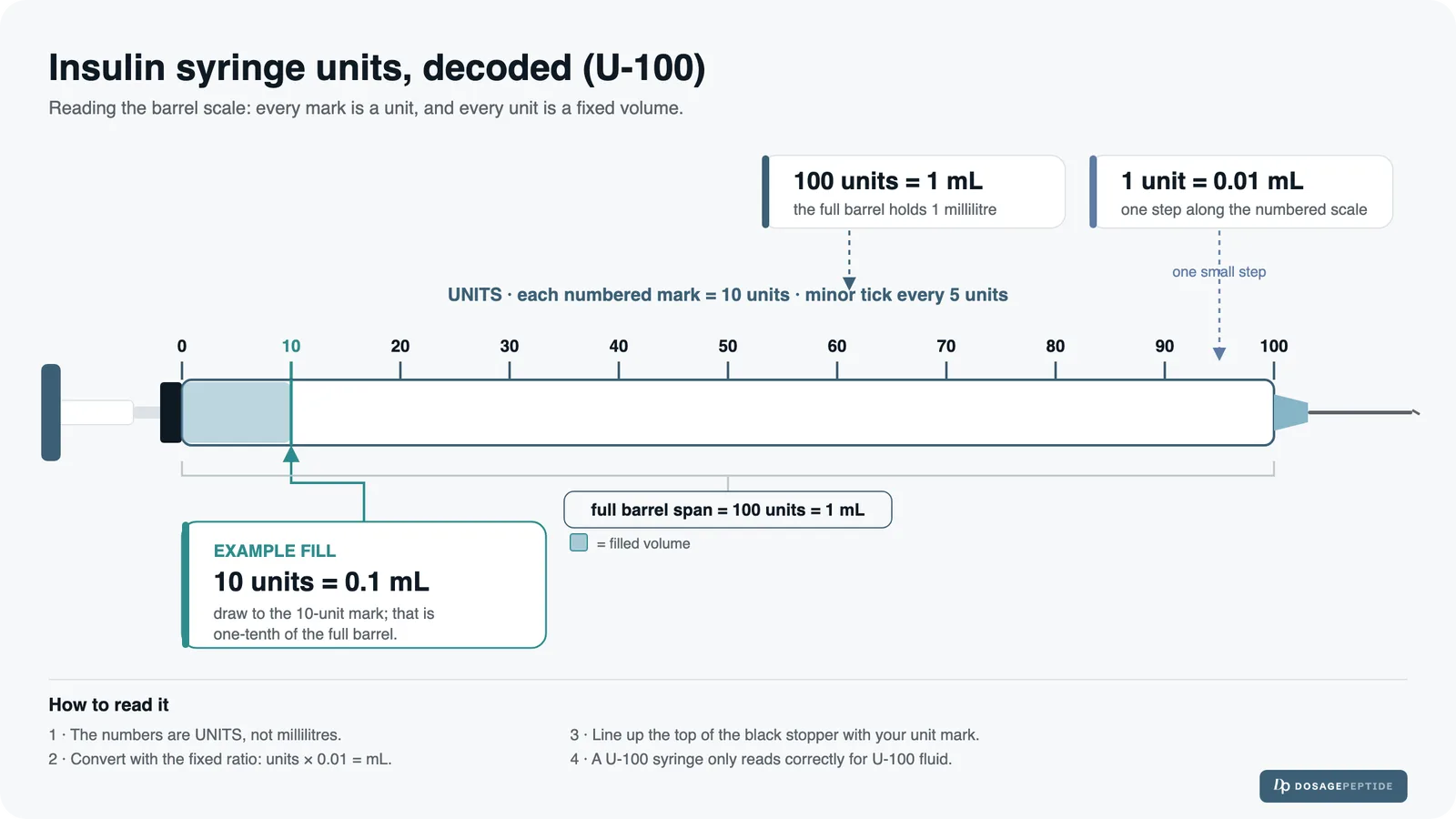
The numbers on an insulin syringe — 10, 20, 30 — are not milligrams, and they are not your dose. They are units of volume. On a standard U-100 syringe, 1 unit = 0.01 mL. That is the whole conversion: 50 units is half a millilitre, 100 units is a full one. The syringe neither knows nor cares which peptide is inside — it only measures how much liquid you pull.
Which is why “how many units is 250 mcg?” has no single answer. It depends entirely on how concentrated your solution is. The chart below gives the number for every common concentration, and the rest of the page shows how to read the barrel so the number you draw is the number you meant.
This is a research-use-only measurement explainer: it teaches you to read a syringe barrel, not how much of any peptide to draw. Every product referenced is for laboratory and research use only; the actual figures live on each protocol page.

How many units is 250 mcg? (and other common amounts)
The formula is one line:
units (U-100) = mcg ÷ (10 × concentration in mg/mL)
Concentration is fixed the moment the vial is reconstituted: total mg of peptide divided by the mL of bacteriostatic water added. A 5 mg vial reconstituted with 2 mL is 2.5 mg/mL. Find your concentration across the top of the table, your amount down the side, and read off the units.
| Amount | 1 mg/mL | 2 mg/mL | 2.5 mg/mL | 5 mg/mL | 10 mg/mL |
|---|---|---|---|---|---|
| 100 mcg | 10 u | 5 u | 4 u | 2 u | 1 u |
| 200 mcg | 20 u | 10 u | 8 u | 4 u | 2 u |
| 250 mcg | 25 u | 12.5 u | 10 u | 5 u | 2.5 u |
| 300 mcg | 30 u | 15 u | 12 u | 6 u | 3 u |
| 500 mcg | 50 u | 25 u | 20 u | 10 u | 5 u |
| 750 mcg | 75 u | 37.5 u | 30 u | 15 u | 7.5 u |
| 1000 mcg (1 mg) | 100 u | 50 u | 40 u | 20 u | 10 u |
| 2000 mcg (2 mg) | —* | 100 u | 80 u | 40 u | 20 u |
*2 mg at 1 mg/mL is 2 mL — 200 units, which does not fit in a 1 mL syringe.
Two things to notice. First, 250 mcg is anything from 2.5 to 25 units depending on concentration — a tenfold spread. Anyone who tells you “250 mcg is 10 units” without asking about your vial is quoting the 2.5 mg/mL case and nothing more. Second, at high concentrations the volume gets small enough that a single mis-read tick is a large proportional error; a 30-unit barrel spreads those numbers out.
Prefer not to do the arithmetic? Our calculator does the conversion from vial size, water volume and target amount.
Units to mL: the 60-second answer
A syringe measures liquid volume — nothing else. The “units” printed on it are just a fine volume scale; they say nothing about milligrams or micrograms of peptide. Keep those two ideas apart and you have already avoided the biggest beginner error: units ≠ dose, units ≠ mg.
“U-100” means 100 units per millilitre, so every unit is one-hundredth of a millilitre. Memorise three numbers and you are essentially done:
- 10 units = 0.1 mL
- 50 units = 0.5 mL
- 100 units = 1 mL
Everything else is detail around those three. All values below assume a U-100 syringe:
| Units (U-100) | Millilitres (mL) | Microlitres (µL) |
|---|---|---|
| 5 units | 0.05 mL | 50 µL |
| 10 units | 0.1 mL | 100 µL |
| 20 units | 0.2 mL | 200 µL |
| 25 units | 0.25 mL | 250 µL |
| 30 units | 0.3 mL | 300 µL |
| 50 units | 0.5 mL | 500 µL |
| 75 units | 0.75 mL | 750 µL |
| 100 units | 1 mL | 1000 µL |
Read it in either direction: 0.5 mL is 50 units on a U-100 syringe, and 0.3 mL is 30 units. To go from mL to units, multiply by 100. To go from units to mL, divide by 100.
Read the barrel in three checks
- Confirm it says U-100. The 1 unit = 0.01 mL rule only holds on a U-100 syringe. If the barrel or wrapper reads anything else, the numbers mean something different (see the U-40 trap below). For the term itself, see the glossary.
- Count the ticks yourself. Numbered major lines (10, 20, 30…) have smaller ticks between them, and each tick is worth 1 unit on some barrels and 2 on others. Count the gaps between “0” and “10”: ten gaps means 1 unit each, five gaps means 2 units each. Never assume — count.
- Read to the flat front edge of the plunger stopper — the edge nearest the needle, where the rubber meets the liquid — every single time. Reading the trailing, angled tip is a quiet but consistent source of error.
Barrels come in three sizes — 0.3 mL (30-unit), 0.5 mL (50-unit), and 1 mL (100-unit) — all on the same U-100 scale. A smaller barrel spreads a small volume across more physical space, so tiny amounts are easier to read precisely.
From units to an actual amount
The syringe gives you a volume; concentration (mg or mcg per mL, fixed the moment the vial was reconstituted) turns that volume into an amount: amount = volume × concentration. The syringe handles the volume half; how much water you added — see how much bacteriostatic water to use — handles the concentration half.
Illustrative only, not a recommendation for any peptide. At 2 mg/mL, drawing to 25 units means 0.25 mL, and 0.25 mL × 2 mg/mL = 0.5 mg (500 mcg). Change the concentration and the same 25 units would hold a different amount — which is exactly why a syringe number on its own can never be a “dose.” The units to draw for a specific compound live on its protocol page, or on the blend pages for multi-peptide vials.
The mistakes that cause real errors
- Reading units as milligrams. “Draw 20” means 20 units of liquid, never 20 mg of anything.
- Quoting a unit number without its concentration. The single most common error in peptide forums. “I take 10 units” is meaningless information unless the vial and the water volume come with it.
- The U-40 trap. A U-40 syringe is scaled to 40 units per mL, so 1 unit = 0.025 mL — 2.5× more than U-100. Confusing the two is a well-documented overdose route; match your syringe to the numbers you are working from and never swap scales mid-task.
- Air bubbles. A bubble takes up space the liquid should fill, so your real volume is short. Tap the barrel, float the bubbles up to the needle, and clear them before you read.
- Too big a barrel for a tiny volume. Four units on a 100-unit barrel is cramped and imprecise; a 30- or 50-unit barrel spreads the scale out.
Frequently Asked Questions
How many units is 250 mcg on a syringe?
It depends on the concentration. On a U-100 syringe: 25 units at 1 mg/mL, 12.5 units at 2 mg/mL, 10 units at 2.5 mg/mL, 5 units at 5 mg/mL, and 2.5 units at 10 mg/mL. The formula is units = mcg ÷ (10 × mg/mL).
How many units is 0.5 mL?
50 units on a U-100 syringe, since 1 unit = 0.01 mL. On a U-40 syringe the same 0.5 mL would read as 20 units — which is why the scale on the barrel has to be checked first.
How many units is 500 mcg?
50 units at 1 mg/mL, 25 units at 2 mg/mL, 20 units at 2.5 mg/mL, 10 units at 5 mg/mL, 5 units at 10 mg/mL — all on a U-100 syringe.
Is 1 unit the same as 1 mg?
No. A unit is a volume (0.01 mL on U-100); milligrams are mass. How many mg sit in a given number of units depends entirely on your solution’s concentration.
How many units are in 1 mL?
100, on a U-100 syringe — that is precisely what “U-100” means: 100 units per millilitre.
Can I use a U-40 syringe?
Only if your numbers are calibrated for it. U-40 is 40 units per mL (1 unit = 0.025 mL), a different scale from U-100. Confusing the two is a documented dosing error, so pick one scale and stay on it.
Why read to the front edge of the plunger?
The flat front face of the rubber stopper is where it meets the liquid; reading the angled back tip adds a small, repeatable error to every draw.
References
- American Diabetes Association. Standards of Care in Diabetes — insulin administration and the U-100 (100 units/mL) syringe standard.
- Institute for Safe Medication Practices (ISMP). Safety guidance on U-100 versus U-40 insulin syringe confusion and unit-measurement errors.
- Becton Dickinson (BD). U-100 insulin syringe specifications (0.3 mL / 0.5 mL / 1 mL barrels; 1 unit = 0.01 mL).
- Dosage Peptide internal references: the dosage calculator and the peptide reconstitution guide.
Research-use-only disclaimer: This article is for informational and educational purposes only and describes how to read a syringe as a measuring instrument. It is not medical advice, not a recommendation to use any peptide, and not a prescription of any dose. All illustrative numbers are examples only. Peptides referenced on this site are intended for laboratory and research use only and are not for human consumption. Consult a qualified professional before making any health-related decision.