Short answer: in rodent models of colitis and gut injury, BPC-157 reliably reduced inflammation and sped up healing of the intestinal lining. In humans, none of that has been confirmed. A BPC-157-based agent, PL 14736, did reach a randomised Phase II trial as an enema in mild-to-moderate ulcerative colitis — and the efficacy results were never published. So the animal evidence is real and reproducible; the human evidence is, in practical terms, missing.
If you live with Crohn’s disease or ulcerative colitis, nothing on this page changes what your care should look like. BPC-157 is not an approved treatment for inflammatory bowel disease anywhere, and no trial has ever compared it against the drugs that are. What follows is what the published record actually contains: how the peptide is proposed to work, what the colitis and anastomosis models showed, why the human programme went quiet, how it compares with established IBD therapeutics, and which widely-quoted percentages circulating online cannot be traced to any study. For how doses are expressed and reconstituted in research settings, see the BPC-157 dosage reference. This is a research-use-only reference, not medical advice.
The question in this article’s title carries a quiet assumption worth surfacing before we go further. To ask how BPC-157 influences inflammation and mucosal repair in inflammatory bowel disease (IBD) models implies that it does so — that the mechanism is settled and only the details remain to be filled in. The honest picture is more restrained. There is a genuine, reproducible body of preclinical work in which the pentadecapeptide BPC-157 accelerated healing of experimentally injured gut tissue in rodents, and there is a real, if incompletely reported, clinical program that once carried a BPC-157-based agent into human ulcerative-colitis trials.1 But almost all of the mechanistic detail comes from animals, much of the confident causal language circulating online outruns the primary data, and the pivotal human results were never published in full. So the useful posture is neither dismissal nor enthusiasm: it is to lay out what the models actually show, what mechanism they plausibly support, and where the story stops being evidence and becomes extrapolation.
This piece is written for researchers and scientifically literate readers who want an accurate map rather than a sales pitch. BPC-157 is not approved by the U.S. Food and Drug Administration or any comparable regulator for IBD or for any other condition; it is an investigational compound, and its IBD-relevant data are overwhelmingly rodent data. Nothing here should be read as suggesting the peptide treats, cures, or prevents Crohn’s disease, ulcerative colitis, or any illness. With that framing fixed, the mechanistic question is legitimately interesting, because BPC-157’s proposed biology — angiogenesis, nitric-oxide signaling, and epithelial restitution — maps unusually well onto the two things that define recovery in IBD: quieting inflammation and rebuilding mucosa.
We will move from definitions to mechanism to the actual experiments, then to the human gap, comparisons with established IBD drugs, methodology, safety, limitations, and regulatory status. Throughout, the guiding discipline is to distinguish three tiers that popular writing tends to blur: what has been demonstrated in a controlled model, what is mechanistically proposed and partly supported, and what is simply asserted. For a broader primer on the molecule itself, the site’s pillar explainer on what BPC-157 is is a useful companion; this article narrows to the specific angle of inflammation and mucosal repair in IBD-type models.
What BPC-157 Is, and What “IBD Models” Actually Mean
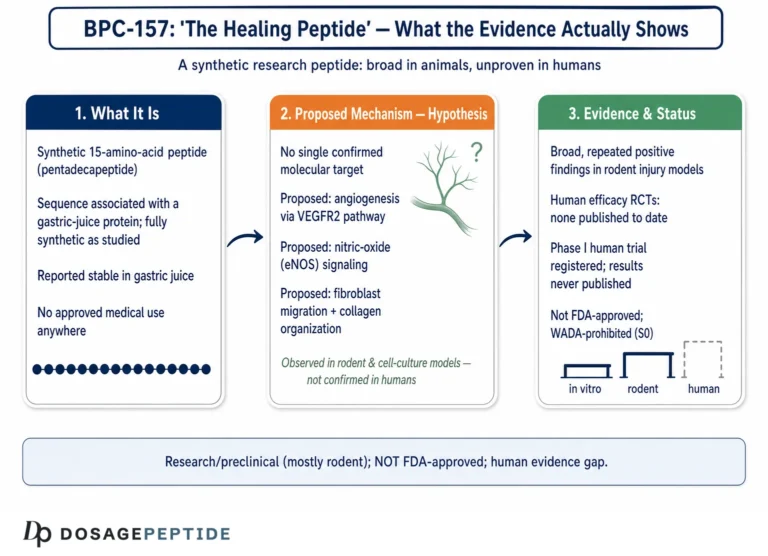
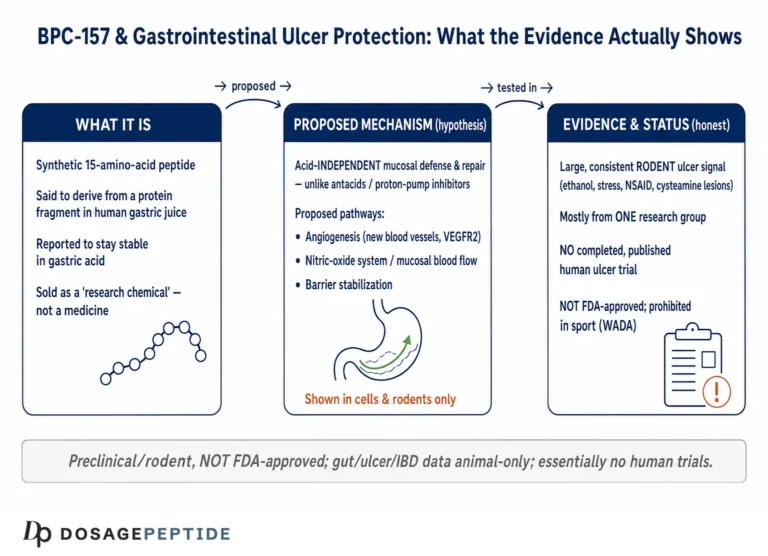
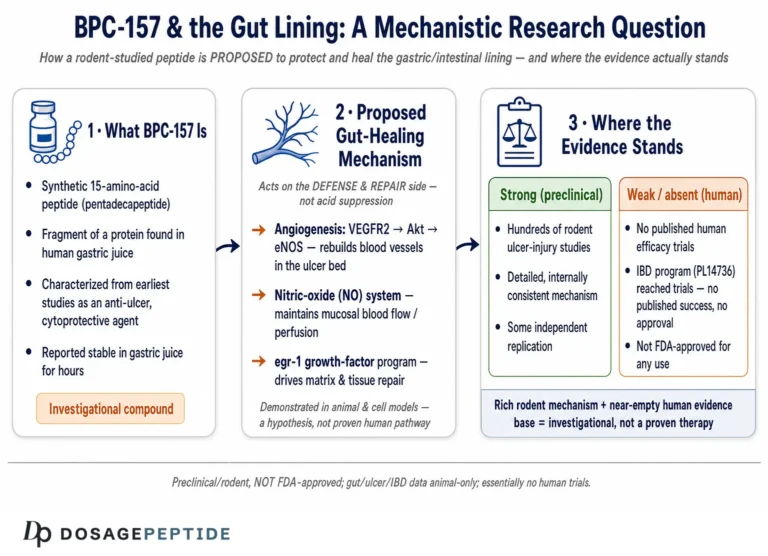
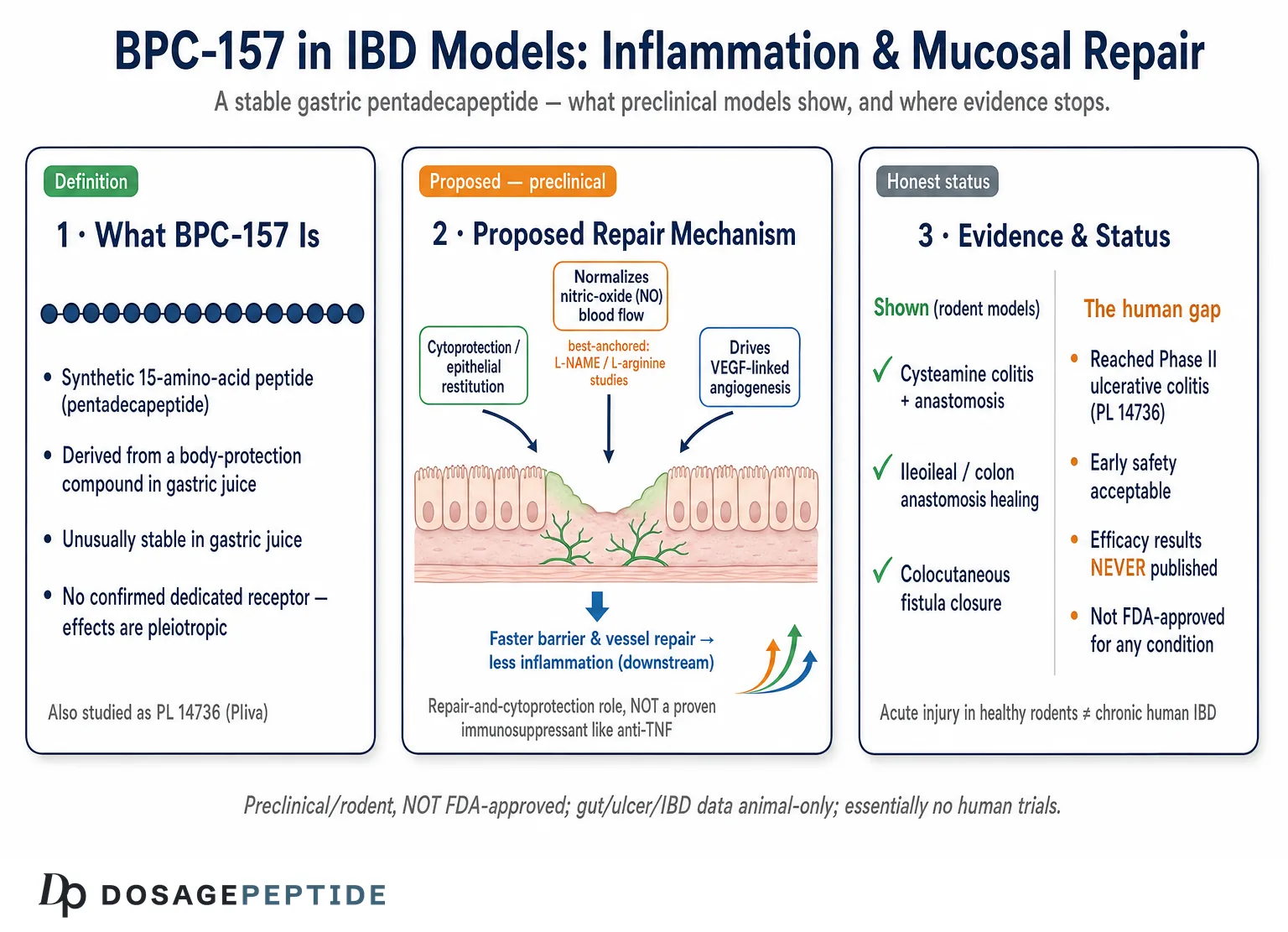
BPC-157 is a synthetic pentadecapeptide — a chain of fifteen amino acids — with the sequence Gly-Glu-Pro-Pro-Pro-Gly-Lys-Pro-Ala-Asp-Asp-Ala-Gly-Leu-Val. It is described in the primary literature as a partial sequence derived from a body protection compound (BPC) identified in human gastric juice, and its defining laboratory property is unusual stability: it is reported to remain intact in human gastric juice for extended periods, which is atypical for small peptides and is the reason it is often called the “stable gastric pentadecapeptide.”1 That stability matters for the gut specifically, because it implies the molecule can survive the luminal environment long enough to act locally on the mucosa rather than being immediately degraded.
Crucially, BPC-157 is a synthetic construct, not a fragment cleaved from a known circulating hormone with a defined receptor. Unlike growth factors that act through a single, well-mapped receptor tyrosine kinase, BPC-157 has no confirmed dedicated receptor, and its effects are described as pleiotropic — touching angiogenesis, the nitric-oxide system, several growth-factor pathways, and cytoprotective signaling at once.1 This is both the source of its breadth in animal studies and a reason for caution: a compound without a defined receptor and with many proposed downstream effects is inherently harder to characterize rigorously, and easier to over-attribute effects to.
The phrase “IBD models” also deserves precision, because the term hides real heterogeneity, and the fit between any model and human disease is imperfect. Inflammatory bowel disease in humans encompasses two chronic, relapsing-remitting conditions — Crohn’s disease, which can affect any part of the gastrointestinal tract transmurally, and ulcerative colitis, which involves continuous mucosal inflammation of the colon. Both are driven by dysregulated mucosal immunity against the gut microbiota in genetically susceptible hosts, and in both, a central modern treatment goal is mucosal healing — endoscopic and histological resolution of inflammation — which predicts sustained remission and reduced need for surgery better than symptom control alone.2 That endpoint is exactly why a putative mucosal-repair agent attracts interest.
Rodent “IBD models,” however, are not IBD. They are chemically or surgically induced injuries that reproduce features of the disease. The models most relevant to BPC-157’s gut literature include cysteamine-induced colitis and duodenal ulceration, surgical anastomoses (joining two cut ends of bowel, a model of post-operative healing), and colocutaneous and other fistulas.34 Other laboratories model IBD with agents such as trinitrobenzene sulfonic acid (TNBS), acetic acid, or dextran sulfate sodium, each capturing a slightly different slice of the pathology — superficial mucosal injury, transmural inflammation, or barrier disruption. The key honest caveat is that acute, chemically induced injury in a young healthy rodent lacks the chronic, immune-driven, relapsing character of human IBD. A compound that accelerates repair of an acute chemical insult has shown something real and worth knowing, but it has not thereby shown efficacy in the chronic autoimmune-like disease that patients actually have.
The Inflammatory Machinery of IBD — the Target BPC-157 Is Said to Modulate
To judge whether BPC-157’s proposed actions are relevant, it helps to be concrete about what “inflammation” in IBD consists of, because it is not a single dial. The inflamed IBD mucosa is the product of several intertwined failures: a breached epithelial barrier, an over-activated innate and adaptive immune response, a shift toward pro-inflammatory cytokines, oxidative stress, and impaired microvascular perfusion of the healing edge.
At the cytokine level, IBD involves elevated tumor necrosis factor-alpha (TNF-α), interleukin-1β, interleukin-6, and, depending on disease type, T-helper-1 and T-helper-17 skewing with interferon-gamma and IL-17. TNF-α in particular is so central that monoclonal antibodies against it (infliximab, adalimumab) transformed IBD therapy. Alongside cytokines, neutrophil infiltration drives tissue damage through reactive oxygen species and proteases; the histological hallmark of active disease is crypt architecture distortion, ulceration, and inflammatory-cell infiltration of the lamina propria.
Repair, correspondingly, is also multi-step. First comes epithelial restitution — surviving enterocytes at the wound margin flatten and migrate to cover the denuded surface within hours, before any cell division occurs. Then proliferation replaces lost cells, the extracellular matrix is remodeled, and — critically — new blood vessels (angiogenesis) must grow into the granulation tissue to supply oxygen and nutrients to the repairing mucosa. Tight-junction proteins such as occludin and the claudins must be re-established to restore barrier function and stop the self-perpetuating cycle in which luminal antigens leak through a broken barrier and re-ignite inflammation. Mucosal healing, in the sense that predicts good outcomes, requires that all of these succeed and that inflammation resolve rather than merely be suppressed.2
This is the backdrop against which BPC-157’s proposed mechanism becomes interesting. The peptide’s most consistently reported actions in the literature — promotion of angiogenesis, modulation of nitric oxide, upregulation of vascular endothelial growth factor (VEGF), and cytoprotection of the mucosal lining — line up, at least on paper, with the vascular and epithelial arms of repair rather than with direct immunosuppression.3 That is a meaningful distinction from anti-TNF biologics, which primarily suppress the immune signal. Whether BPC-157 also meaningfully dampens the immune signal, or mainly accelerates the rebuilding once injury has occurred, is one of the more genuinely open mechanistic questions, and the animal data speak more clearly to repair than to primary immunomodulation.
How BPC-157 Is Proposed to Dampen Inflammation
The anti-inflammatory case for BPC-157 rests less on a single clean pathway than on a convergence of downstream observations in injured tissue. In colitis and anastomosis models, BPC-157-treated animals repeatedly show fewer inflammatory cells on histology, less necrosis, and reduced macroscopic damage compared with controls.56 The mechanistic interpretation offered in the literature is that this reflects both a direct cytoprotective effect on the mucosa and an indirect quieting of inflammation as the barrier is restored and the pro-inflammatory stimulus (luminal contents reaching exposed tissue) is removed.
A central and relatively well-supported strand is the nitric-oxide (NO) system. Multiple studies use the classic pharmacological probes — the NO-synthase inhibitor L-NAME and the NO precursor L-arginine — to show that BPC-157’s beneficial effects on gut lesions interact with NO signaling, and that BPC-157 can counteract the aggravating effect of L-NAME.34 Nitric oxide is a double-edged mediator in the gut: at physiological levels from endothelial NO synthase it maintains mucosal blood flow and integrity, while excessive inducible-NO-synthase activity in active inflammation contributes to damage. The proposed reading is that BPC-157 helps normalize NO signaling toward the protective, perfusion-supporting side rather than simply raising or lowering it — a modulatory rather than a switch-like effect.4 This is one of the better-anchored parts of the mechanism because it rests on interventional pharmacology (blocking and rescuing the pathway) rather than on correlation alone.
A second strand is the modulation of pro-inflammatory and oxidative burden. Reviews of the gut literature describe BPC-157 counteracting increased free-radical formation and reducing markers of tissue injury, consistent with an antioxidant-adjacent effect that would blunt neutrophil-driven damage.1 It is fair to note that much of this is reported at the level of histology and tissue markers rather than through detailed molecular immunology; there is comparatively little rigorous work isolating BPC-157’s effect on specific cytokine cascades (say, a clean demonstration that it lowers mucosal TNF-α transcription independent of general healing). So the anti-inflammatory claim is best stated conservatively: in injured gut, BPC-157 is associated with a less inflamed histological picture, plausibly through restored perfusion and barrier integrity, with the NO-system as the best-characterized contributing pathway. The claim that it is a primary immunosuppressant, in the way an anti-TNF antibody is, is not well established.
It is worth flagging a recurring overstatement here, because it appears constantly in commercial writing. Specific quantified assertions — that BPC-157 “reduces gut permeability by 63% within 14 days” or “increases VEGF within 48–72 hours” — circulate widely but are difficult to trace to a specific peer-reviewed IBD experiment and should be treated as marketing until a citation is produced. The directional claims (BPC-157 supports barrier proteins, promotes VEGF-linked angiogenesis) have real preclinical grounding; the precise percentages and timelines often do not. A reader serious about this compound should reflexively ask, for any number, which experiment, which species, which model. The site’s companion article on what research says about BPC-157’s gut and inflammation effects covers the broader gut-healing evidence base; the present focus is specifically the IBD-model mechanism.
Mucosal Repair: Angiogenesis, the NO-System, and Epithelial Restitution
If BPC-157’s inflammation story is somewhat indirect, its repair story is where the mechanism is strongest and most internally consistent. The single most reproducible theme across the entire BPC-157 literature — gut, tendon, muscle, skin, and vasculature alike — is a pro-angiogenic, pro-healing effect linked to VEGF and the NO-system.7
Angiogenesis is not a peripheral detail in mucosal healing; it is rate-limiting. Granulation tissue cannot mature and epithelium cannot be sustainably resurfaced without a new capillary bed delivering oxygen. In wound-healing studies, BPC-157 is reported to promote the formation of new blood vessels and to upregulate VEGF expression and its receptor signaling, accelerating the vascular phase of repair.7 A 2025 review frames this pro-angiogenic, NO-system-modulating activity as the peptide’s core pleiotropic mechanism — the common thread that could explain why a single molecule appears to help such diverse tissues, since all wounds need vessels and perfusion.8 Applied to the gut, faster and better-organized angiogenesis at the ulcer margin would plausibly translate into faster mucosal closure.
The NO-system reappears here as the connective tissue of the mechanism. Endothelial NO is a key vasodilator and pro-angiogenic signal; BPC-157’s reported ability to maintain or restore NO-dependent blood flow, and to protect the endothelium, dovetails with its pro-angiogenic effect.4 Several vascular studies in the BPC-157 literature describe rapid rerouting of blood flow and protection of vessels after occlusion or injury, which the authors interpret as evidence that the peptide acts on the vasculature itself, not merely on epithelial cells.8 Whether one finds those vascular-rescue claims fully convincing, they at least point the mechanism consistently at perfusion.
The third pillar is direct cytoprotection and epithelial support, framed by Sikiric and colleagues within a modernized version of Robert’s classic concept of gastric “cytoprotection” — the idea that certain agents protect mucosal cells against injury independent of acid suppression.9 In this framing, BPC-157 is proposed as an endogenous-type mediator that maintains mucosal integrity, supports epithelial survival and migration at the wound edge, and thereby enables the restitution phase that precedes proliferation. The appeal of the cytoprotection framework is that it ties the gut-specific origin of the molecule (gastric juice) to a coherent, pre-existing physiological concept rather than inventing a wholly new mechanism.
Putting the three pillars together yields a plausible integrated model: BPC-157 supports mucosal cell survival and migration (restitution/cytoprotection), normalizes NO-dependent blood flow, and drives VEGF-linked angiogenesis, so that the injured mucosa is both protected and rapidly revascularized, with reduced inflammation as a downstream consequence of restored barrier and perfusion.789 This is a genuinely attractive hypothesis and it is consistent across many experiments. The essential caveat is that “consistent and plausible” is not the same as “proven in IBD”: the mechanism is largely inferred from healthy-rodent injury models, and the causal chain from “more VEGF” to “durable remission of chronic colitis” has not been demonstrated in the disease of interest.
What the Colitis and Anastomosis Models Actually Show
Stepping from mechanism to the concrete experiments makes the evidence base easier to weigh. The most directly IBD-relevant rodent work clusters around chemically induced colitis and surgical bowel healing.
In cysteamine-induced colitis combined with a colon-to-colon anastomosis — a demanding model that stacks chemical injury on top of a surgical wound — control animals healed poorly, failing to resolve either the colitis or the anastomosis, whereas BPC-157 (given intraperitoneally at microgram-to-nanogram-per-kilogram doses, or in drinking water) simultaneously improved both.5 The treated animals showed less necrosis, more epithelialization, new strands of smooth muscle, more granulation tissue, and fewer inflammatory cells — precisely the histological signature of accelerated mucosal repair described in the mechanism section. That a single agent improved a combined chemical-plus-surgical lesion is one of the more striking findings, though it is reported substantially in conference-abstract and review form, which is a lower evidentiary tier than a full primary paper.
The anastomosis literature is more developed. In an ileoileal anastomosis model — joining two cut ends of small bowel, a setting where leakage and failed healing are the feared clinical complications — BPC-157 improved healing of the join, and this work was explicitly framed within the same program that carried the compound (as PL-10, PLD-116, PL14736) toward IBD trials.4 A 2024 review synthesizing the intestinal-anastomosis studies concluded that across multiple such experiments BPC-157 consistently improved anastomotic healing parameters — increased breaking strength, better histology, improved microvasculature — in rats.6 Anastomotic healing is not the same as treating colitis, but it is a legitimate, surgically relevant readout of mucosal and mural repair, and its consistency across studies strengthens the general repair claim.
The fistula work adds another dimension. In a persistent colocutaneous fistula model — an abnormal channel between colon and skin, mimicking the fistulizing complications that plague Crohn’s disease — BPC-157, given either parenterally or orally, accelerated healing of both the colonic and skin defects, leading to functional closure demonstrated macroscopically, microscopically, and biomechanically; the effect interacted with the NO-system, being modulated by L-NAME and L-arginine.3 Fistula healing is notoriously hard to achieve even with modern biologics, so a preclinical signal here is noteworthy — while remaining, again, a rat model of an induced fistula rather than the spontaneous, chronically inflamed fistulas of human Crohn’s disease.
The table below summarizes the principal IBD-relevant models and what they demonstrated, with an explicit column for the honest limitation of each.
| Model | What it mimics | Reported BPC-157 effect | Key limitation |
|---|---|---|---|
| Cysteamine colitis + colon anastomosis | Chemical colitis plus surgical wound | Simultaneous healing of colitis and anastomosis; less necrosis, more epithelialization5 | Largely abstract/review-level reporting; acute injury, not chronic IBD |
| Ileoileal / colon anastomosis | Post-operative bowel healing | Improved anastomotic healing, breaking strength, histology across studies46 | Surgical-repair readout, not colitis remission |
| Colocutaneous fistula | Fistulizing Crohn’s complication | Functional closure of colon and skin defects; NO-system dependent3 | Induced acute fistula in healthy rat, not chronic disease |
| Gastric/duodenal ulcer, NSAID injury | Mucosal ulceration & cytoprotection | Accelerated ulcer healing; cytoprotection via NO-system19 | Upper-GI, not colonic IBD; rodent only |
Read fairly, the pattern is genuinely consistent: across several distinct gut-injury models and multiple laboratories’ framings, BPC-157 is associated with faster, better-organized mucosal and mural repair and a less inflamed histological picture. That consistency is the strongest argument for the compound. The two honest counterweights are that the great majority of these studies originate from a relatively concentrated research network, and that acute induced injury in healthy rodents is a limited surrogate for chronic human IBD. Both facts should temper — without erasing — the preclinical enthusiasm.
Barrier Function, Fistulas, and the Gut-Brain Axis
Two further mechanistic threads deserve their own treatment because they are frequently invoked and partly misunderstood: intestinal barrier function and the gut-brain axis.
On barrier function, the logic is sound and the direction of evidence is favorable, but the specifics are often overstated. A healing mucosa must re-establish tight junctions to stop the leak-inflame-leak cycle, and BPC-157’s pro-restitution, pro-angiogenic profile would be expected to support that re-establishment as a consequence of faster epithelial repair.7 Popular sources go further and cite precise numbers for reductions in permeability or specific upregulation of occludin and claudin-1. Those directional claims are biologically reasonable and partly supported by the general wound-healing literature, but readers should be cautious about exact figures presented as if from a single definitive colitis experiment; the robust statement is qualitative — BPC-157 is associated with improved barrier integrity in injured gut — not a specific percentage. Barrier repair here is best understood as an outcome of the peptide’s core repair mechanism rather than a separate, independently proven action.
The fistula findings, discussed above, connect to barrier and mural repair: closing a colocutaneous or ileoileal defect requires coordinated healing across the full thickness of the bowel wall, not just the surface epithelium, and BPC-157’s effects extended to smooth-muscle regeneration and biomechanical strength in these models.36 This transmural dimension is arguably more relevant to Crohn’s disease, which is itself transmural, than a purely superficial-mucosa mechanism would be — a point in the compound’s favor, tempered by the same acute-versus-chronic caveat.
The gut-brain axis thread is more speculative and should be handled carefully. Sikiric and colleagues have proposed that BPC-157 acts within the brain-gut and gut-brain axis, connecting its gastrointestinal cytoprotection to central-nervous-system effects, and have used this framing to explain observations ranging from mood-related behavior to central injury models.10 For the specific question of IBD inflammation and mucosal repair, the gut-brain axis is at most a contextual mechanism — potentially relevant because IBD does involve bidirectional gut-brain signaling and stress-related flares — but there is no robust evidence that a central pathway is the operative mechanism of BPC-157’s mucosal repair. It is more responsibly cited as an area of hypothesis than as an explanation for gut healing. Readers interested in BPC-157’s neurological claims will find them treated in the site’s dedicated coverage rather than here, where the axis is noted only for completeness. For unfamiliar terms used throughout this discussion, the site’s peptide glossary defines the relevant vocabulary.
The Human Story: PL 14736 and the Unpublished Phase II
Any honest account of BPC-157 and IBD has to confront the single most important and most frequently mishandled fact: a BPC-157-based agent did reach human clinical trials for ulcerative colitis, and yet the definitive efficacy results were never published in the peer-reviewed literature. Both halves of that sentence matter.
The compound was developed by the Croatian pharmaceutical company Pliva under a succession of designations — PL-10, PLD-116, and finally PL 14736 — and advanced through early human work.4 A first-in-human study reported that rectal administration of PL 14736 to healthy male volunteers was safe and well tolerated, establishing an acceptable short-term safety and pharmacokinetic profile and clearing the way for patient trials.11 On the strength of that, a randomized, double-blind, placebo-controlled study of PL 14736 enema was undertaken in patients with mild-to-moderate ulcerative colitis. This is the closest BPC-157 has ever come to demonstrated human efficacy in IBD.
Here the trail goes cold in a way researchers should sit with. The Phase II ulcerative-colitis results were, by all accounts, not published as a standalone peer-reviewed clinical paper, and the program did not progress to approval. The reasons are not transparent from the public record — they could include commercial decisions after Pliva’s acquisition, insufficient efficacy, endpoint or formulation problems, or simple deprioritization — but from an evidence standpoint the effect is the same: there is no published, independently scrutinizable dataset establishing that BPC-157/PL 14736 produces mucosal healing or clinical remission in human ulcerative colitis. What exists in the peer-reviewed literature is the safety/tolerability groundwork and abundant animal data; the pivotal efficacy readout is essentially a gap.11
The correct interpretation is neither “it failed” nor “it worked” — both overstate what the record supports. The defensible statement is that BPC-157 reached Phase II for ulcerative colitis with acceptable early safety, and that its efficacy in that setting remains unproven because the results were never published. An unpublished trial is, for scientific purposes, closer to no trial than to a positive one, because publication bias runs the other way: programs with clean, strong positive pivotal data usually publish and pursue approval. The absence of a published positive Phase II is therefore mildly discouraging, not reassuring, however one weighs it. This is the crux of the honesty problem with BPC-157 and IBD: the mechanism is attractive and the animal data are consistent, but the one human efficacy test that mattered is missing from the record.
How BPC-157 Compares With Established IBD Therapeutics
Placing BPC-157 beside drugs that are approved for IBD clarifies both what a proven therapy looks like and where BPC-157 actually sits. The contrast is not a competition — BPC-157 has never been through the trials these agents cleared — but it calibrates expectations.
| Agent / class | Primary mechanism | Highest evidence level in IBD | Regulatory status |
|---|---|---|---|
| Anti-TNF antibodies (infliximab, adalimumab) | Neutralize TNF-α, suppressing the inflammatory signal | Multiple pivotal RCTs; mucosal-healing benefit established2 | FDA/EMA approved for IBD |
| Anti-integrin (vedolizumab) | Blocks gut-selective leukocyte trafficking | Pivotal RCTs in UC and Crohn’s | FDA/EMA approved |
| Aminosalicylates (mesalamine) | Local anti-inflammatory in colonic mucosa | Decades of RCTs, especially mild-moderate UC | FDA/EMA approved |
| Corticosteroids | Broad immunosuppression | Effective for induction; not maintenance | Approved; limited by toxicity |
| BPC-157 (PL 14736) | Pro-angiogenic, NO-system modulation, cytoprotection/restitution | Rodent injury models; Phase II UC reached but results unpublished411 | Not approved anywhere; investigational |
Two things stand out. First, the approved agents all act primarily by suppressing the immune/inflammatory signal, and each carries a documented mucosal-healing benefit from published randomized trials. BPC-157’s proposed niche is conceptually different — it is pitched as a repair-and-cytoprotection agent that accelerates rebuilding rather than switching off immunity. In principle that could be complementary to immunosuppression rather than competitive with it, which is part of why the concept is interesting. But this is a hypothesis about a role, not a demonstrated one.
Second, the evidence-level gap is stark. The approved drugs earned their place through published, replicated, controlled human trials with mucosal-healing endpoints; BPC-157 has consistent animal data and an unpublished human Phase II. That is not a small difference in degree; it is a difference in kind. A researcher should treat BPC-157 as an interesting investigational repair-modulator whose human IBD efficacy is unestablished, not as an alternative to therapies that carry regulatory approval. For a sense of how other repair-oriented peptides are discussed in relation to chronic inflammation, the site’s piece on TB-500 and chronic inflammatory conditions offers a useful parallel in evidentiary caution, and the broader BPC-157 inflammation and joint-pain discussion examines the same molecule’s anti-inflammatory claims outside the gut.
Research Models and Methodology
Understanding how BPC-157’s gut data were generated clarifies what they can and cannot support. The methodology spans three tiers, and the strength of inference differs sharply across them.
Interventional pharmacology in rodents. The most methodologically informative BPC-157 gut work uses the NO-system probe design: pairing BPC-157 with L-NAME (to block NO synthesis) and L-arginine (to supply NO substrate) and observing how the peptide’s effect changes.34 Because this manipulates a candidate mechanism directly rather than merely correlating it, it is stronger evidence than histology alone, and it is the reason the NO-system claim is the best-anchored part of the mechanism. Dose-ranging across the characteristically wide BPC-157 range (microgram to nanogram per kilogram) and multiple delivery routes (intraperitoneal, oral in drinking water) also feature in the better studies.5
Descriptive model studies. Much of the colitis, anastomosis, and fistula work reports macroscopic damage scores, histological grading, breaking strength, and marker expression comparing treated versus control animals.46 These are legitimate and standard preclinical endpoints, and their consistency across models is real. Their limitations are equally real: acute induced injury in young healthy rodents, frequent reliance on the same core research group, variable reporting quality, and a notable amount of important-sounding data appearing first (or only) in conference abstracts and narrative reviews rather than in fully detailed primary papers subjected to independent replication.5 Independent replication by unrelated laboratories is the single thing the field most needs and most lacks.
Human studies. The human methodology was appropriate as far as it went: a first-in-human safety and pharmacokinetic study by rectal administration, followed by a randomized, double-blind, placebo-controlled Phase II enema trial in ulcerative colitis.11 The design was exactly what one would want. The problem is not the design but the disposition of the results, which were not published in a form that allows independent evaluation of efficacy or mucosal-healing endpoints. A rigorous future program would require published, replicated randomized controlled trials in defined IBD populations, with endoscopic and histological mucosal-healing endpoints of the kind now standard in the field.2
The methodological bottom line is that BPC-157’s IBD-relevant evidence is architecturally lopsided: mechanistically probing and reproducible in rodents, but thin, concentrated in source, and — at the human level — unpublished where it counts. Any confident statement about mechanism in human IBD outruns this architecture.
Safety, Sourcing, and Research Handling
Short-term safety is one area where BPC-157’s record is relatively reassuring, but the statement has to be carefully bounded. In the animal literature, BPC-157 is repeatedly reported as remarkably well tolerated, with no established toxic dose and a wide therapeutic window, and its cytoprotective framing casts it as protective rather than injurious to tissue.19 In the one relevant human study, rectal PL 14736 was safe and well tolerated in healthy male volunteers over the short term.11 Those are genuine, if limited, safety signals.
Several caveats keep this from being a clean bill of health for anyone contemplating the compound outside research:
- No long-term or IBD-population human safety data. Safety in healthy volunteers over a short window says little about repeated long-term administration to chronically ill IBD patients, who have altered gut physiology, comorbidities, and concurrent medications.
- A pro-angiogenic profile cuts both ways. The very mechanism proposed to heal — driving new blood-vessel growth — warrants caution in any setting where unwanted angiogenesis is a concern (for example, malignancy), a theoretical risk that has not been resolved in humans.8
- Regulatory-safety signals exist. BPC-157 was placed by the FDA in a category reflecting identified potential safety risks and insufficient characterization for compounding use — a bureaucratic judgment, but one that reflects genuine gaps in immunogenicity and impurity data for a synthetic peptide.12
- Product quality is a real hazard. Most material sold outside regulated channels is labeled “research chemical” of unverified purity. Endotoxin, incorrect sequence, and mislabeled content are sourcing risks entirely separate from the molecule’s intrinsic pharmacology, and they matter especially for a compound intended to contact inflamed, barrier-compromised gut.
The reasonable reading is that BPC-157 has not produced major short-term safety alarms in the limited populations studied, that its animal safety margin appears wide, and that this provides no assurance about long-term use in patients and no evidence of benefit. Absence of demonstrated harm and absence of demonstrated efficacy coexist here.
On the practical side, because BPC-157 is most often encountered as a lyophilized (freeze-dried) powder, a brief, strictly educational note on laboratory handling is warranted — with the emphasis that this describes standard research-peptide practice, not a usage recommendation, and that BPC-157 is not an approved therapeutic for IBD or anything else.
Lyophilized peptides are generally reconstituted with sterile or bacteriostatic water for laboratory purposes. The diluent is directed slowly against the inner wall of the vial rather than sprayed onto the powder, and the vial is swirled gently rather than shaken, because vigorous agitation can shear peptide bonds and denature material. The chosen diluent volume simply sets the concentration: a fixed mass dissolved in a larger volume yields a lower concentration per unit volume, which is the arithmetic behind any reconstitution chart. General principles for this process are laid out in the site’s peptide reconstitution guide, which is educational reference material rather than guidance for human use.
| Parameter | Typical research-context practice |
|---|---|
| Lyophilized storage | Cool, dark conditions; freezing favors long-term stability |
| After reconstitution | Refrigerated; used within a limited window |
| Light and heat | Minimize exposure; both degrade peptides |
| Agitation | Swirl gently; avoid shaking or foaming |
| Freeze-thaw | Repeated cycles degrade peptides; avoid |
| Sterility | Aseptic technique; bacteriostatic water for multi-use practice |
Meticulous handling changes nothing about the evidence question. A perfectly reconstituted, high-purity vial of BPC-157 is still a compound whose human IBD efficacy is unproven. Good technique preserves whatever biological activity the molecule has; it does not create clinical efficacy where none has been demonstrated.
Limitations and the Evidence Gap
Pulling the threads together, the limitations bearing on the inflammation-and-mucosal-repair question in IBD are substantial, and they compound one another.
Species and model gap. Nearly all mechanistic evidence comes from acute, chemically or surgically induced injury in healthy rodents.56 Human IBD is chronic, relapsing, immune-driven, and heterogeneous. Accelerating repair of an acute rat lesion is real but does not establish control of chronic human inflammation.
The unpublished human pivotal. The one Phase II ulcerative-colitis trial that could have converted mechanism into evidence was not published, leaving human efficacy unestablished and, given publication norms, mildly discouraging rather than reassuring.11
Source concentration and replication. A large share of the favorable gut literature originates from a concentrated research network, and independent replication by unrelated groups is limited. Extraordinary breadth of claimed effect across many tissues raises, rather than lowers, the bar for independent confirmation.
Mechanism inferred, not fully proven. The angiogenesis/NO/cytoprotection model is plausible and internally consistent, and the NO-system arm is supported by interventional pharmacology, but the causal chain from these actions to durable remission of chronic colitis has not been shown, and some widely repeated quantitative claims lack traceable primary sources.78
Sourcing and standardization. As an unapproved compound, real-world BPC-157 varies in purity and provenance, confounding even informal observation.12
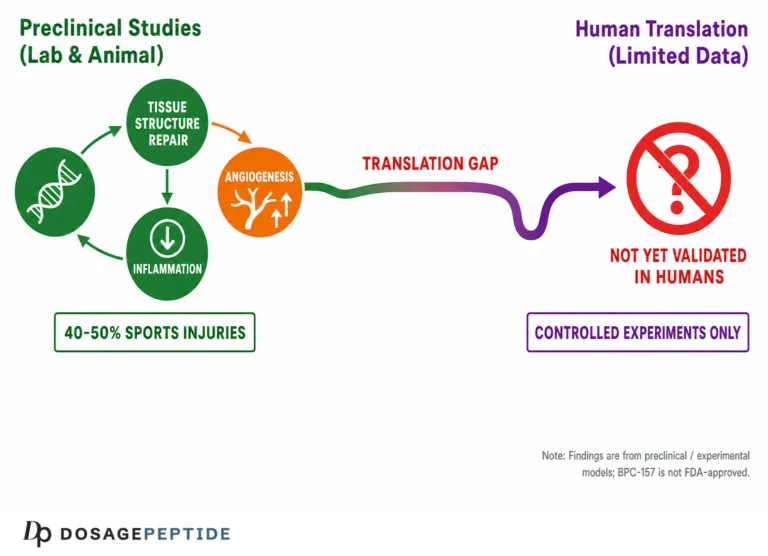
The evidence gap here is specific and nameable: it is the gap between a consistent preclinical repair signal and an unpublished, therefore unusable, human efficacy result. Responsible communication means holding both facts at once — the mechanism is genuinely interesting and the animal data are real, and human IBD efficacy is unproven. Neither half licenses the confident therapeutic claims common online. Readers tracking how this and related evidence evolves can follow the peptide literature through the site’s broader reference catalog, organized for educational use rather than as clinical guidance.
Regulatory Status
BPC-157’s regulatory picture is frequently misrepresented, so precision matters.
No therapeutic approval, anywhere. BPC-157 is not approved as a drug for IBD, ulcerative colitis, Crohn’s disease, or any other condition by the FDA, the European Medicines Agency, or any comparable regulator. Despite reaching Phase II for ulcerative colitis as PL 14736, it never obtained marketing approval, and no approved indication exists that could be extended to IBD.11
U.S. compounding status. The FDA evaluated BPC-157 in the context of Section 503A bulk drug substances used in compounding and placed it in the category reflecting identified potential safety risks pending further evaluation, citing gaps such as inadequate characterization and immunogenicity concerns for the synthetic peptide.12 That status has since been under active reconsideration: in 2026 the agency moved to revisit BPC-157’s placement and referred the substance to its Pharmacy Compounding Advisory Committee for review rather than leaving it fixed in the safety-risk category. It is essential not to misread this procedural step — removal from a safety-concern category is not approval, does not by itself place BPC-157 on the permitted list of substances usable in compounding, and does nothing to establish efficacy for IBD or any other condition. The compound remains unapproved throughout. The practical implication is that material marketed to consumers or clinics generally sits outside approved-drug oversight, and the regulatory picture is best described as unsettled and in flux rather than resolved in the compound’s favor.
Research-use framing. Consequently, BPC-157 is widely sold and labeled “for research use only,” a designation that explicitly disclaims human therapeutic use and quality assurances associated with approved medicines. That framing is not a loophole conferring legitimacy; it is a signal that the compound has not cleared the evidence and manufacturing bar required for therapeutic use.
The regulatory synthesis is straightforward: BPC-157 is an investigational compound with no approved therapeutic use, an unresolved compounding status, and a single unpublished human IBD trial in its history. Any legitimate exploration of its effects on inflammation and mucosal repair should occur within properly authorized preclinical or clinical research under appropriate oversight — not through informal or off-label use.
Frequently Asked Questions
Does BPC-157 actually heal inflammatory bowel disease?
There is no published human evidence that it does. In rodent models of chemically induced colitis, bowel anastomoses, and fistulas, BPC-157 consistently accelerated mucosal and mural repair and produced a less inflamed histological picture.56 But these are acute injuries in healthy animals, not chronic human IBD, and the one human Phase II ulcerative-colitis trial (as PL 14736) was never published, so human efficacy is unproven.11 BPC-157 is not approved for IBD anywhere.
How is BPC-157 proposed to reduce inflammation in the gut?
The best-supported mechanism is indirect: BPC-157 is thought to protect mucosal cells (cytoprotection), normalize nitric-oxide-dependent blood flow, and drive VEGF-linked angiogenesis, so that faster barrier and vascular repair removes the stimulus that perpetuates inflammation.378 The nitric-oxide arm is the best-anchored part, shown through experiments blocking and restoring the pathway with L-NAME and L-arginine.4 Evidence that it acts as a primary immunosuppressant, like anti-TNF drugs, is weak.
What does “mucosal repair” mean, and why does it matter in IBD?
Mucosal repair (or mucosal healing) is the endoscopic and histological resolution of inflammation and re-coverage of the gut lining, achieved through epithelial restitution, proliferation, angiogenesis, and restored tight junctions. In IBD it is a key treatment goal because it predicts sustained remission and reduced surgery better than symptom relief alone.2 BPC-157’s proposed repair-oriented mechanism is what makes it conceptually interesting for this endpoint — though the interest remains preclinical.
Was BPC-157 ever tested in humans for colitis?
Yes. As PL 14736, developed by Pliva, it passed a first-in-human safety study by rectal administration and entered a randomized, double-blind, placebo-controlled Phase II trial of an enema formulation in mild-to-moderate ulcerative colitis.11 Short-term safety was acceptable, but the efficacy results were never published in a peer-reviewed clinical paper and the program did not reach approval, so its effectiveness in human IBD remains unestablished.
Are the specific numbers online (e.g., “reduces permeability 63%”) trustworthy?
Treat them with skepticism. The directional claims — that BPC-157 supports barrier proteins and promotes VEGF-linked angiogenesis — have real preclinical grounding.7 But precise percentages and timelines that circulate in commercial writing are often not traceable to a specific peer-reviewed IBD experiment. For any number, ask which study, which species, and which model produced it.
How does BPC-157 differ from approved IBD drugs?
Approved agents such as anti-TNF antibodies, vedolizumab, and aminosalicylates work mainly by suppressing the immune/inflammatory signal and are backed by published randomized trials with mucosal-healing endpoints.2 BPC-157 is pitched differently — as a repair-and-cytoprotection agent that accelerates rebuilding — and could in theory be complementary, but it has no published human efficacy data and no approval.11 The evidence gap between them is a difference in kind, not degree.
Is BPC-157 legal or FDA-approved?
It is not approved as a drug for any condition. The FDA evaluated it for compounding under Section 503A and placed it in a category reflecting identified potential safety risks pending further evaluation.12 It is widely sold “for research use only,” a label that disclaims therapeutic use rather than authorizing it.
Is BPC-157 safe?
Animal studies report a wide safety margin and no established toxic dose, and short-term rectal use was well tolerated in healthy human volunteers.111 But there are no long-term human safety data, none in IBD patients specifically, a theoretical concern from its pro-angiogenic activity, and real risks from unregulated product quality.812 Short-term tolerability is not the same as proven long-term safety in sick populations.
References
- Sikiric P, Seiwerth S, Rucman R, et al. Stable gastric pentadecapeptide BPC 157: novel therapy in gastrointestinal tract. Curr Pharm Des. 2011;17(16):1612-1632. PMID: 21548867. https://pubmed.ncbi.nlm.nih.gov/21548867/
- Neurath MF, Travis SPL. Mucosal healing in inflammatory bowel diseases: a systematic review. Gut. 2012;61(11):1619-1635. PMID: 22842618. https://pubmed.ncbi.nlm.nih.gov/22842618/
- Klicek R, Sever M, Radic B, et al. Pentadecapeptide BPC 157, in clinical trials as a therapy for inflammatory bowel disease (PL14736), is effective in the healing of colocutaneous fistulas in rats: role of the nitric oxide-system. J Pharmacol Sci. 2008;108(1):7-17. PMID: 18818478. https://pubmed.ncbi.nlm.nih.gov/18818478/
- Vuksic T, Zoricic I, Brcic L, et al. Stable gastric pentadecapeptide BPC 157 in trials for inflammatory bowel disease (PL-10, PLD-116, PL14736, Pliva, Croatia) heals ileoileal anastomosis in the rat. Surg Today. 2007;37(9):768-777. PMID: 17713731. https://pubmed.ncbi.nlm.nih.gov/17713731/
- Sikiric P, Seiwerth S, Rucman R, et al. Stable gastric pentadecapeptide BPC 157 for colitis and multiple sclerosis: healing of cysteamine-colitis and colon-colon-anastomosis. FASEB J. 2013;27(Suppl 1):1093.18. DOI: 10.1096/fasebj.27.1_supplement.1093.18. https://faseb.onlinelibrary.wiley.com/doi/10.1096/fasebj.27.1_supplement.1093.18
- Bajramagic S, Sever M, Rasic F, et al. Stable gastric pentadecapeptide BPC 157 and intestinal anastomoses therapy in rats—a review. Pharmaceuticals (Basel). 2024;17(8):1081. PMID: 39204186. https://pubmed.ncbi.nlm.nih.gov/39204186/
- Seiwerth S, Milavic M, Vukojevic J, et al. Stable gastric pentadecapeptide BPC 157 and wound healing. Front Pharmacol. 2021;12:627533. PMID: 34267654; PMCID: PMC8275860. https://pmc.ncbi.nlm.nih.gov/articles/PMC8275860/
- Sikiric P, Seiwerth S, Skrtic A, et al. Stable gastric pentadecapeptide BPC 157 as a therapy and safety key: a special beneficial pleiotropic effect controlling and modulating angiogenesis and the NO-system. Pharmaceuticals (Basel). 2025;18(6):928. PMID: 40573323; PMCID: PMC12195719. https://pmc.ncbi.nlm.nih.gov/articles/PMC12195719/
- Sikiric P, Hahm KB, Blagaic AB, et al. Stable gastric pentadecapeptide BPC 157, Robert’s stomach cytoprotection/adaptive cytoprotection/organoprotection, and Selye’s stress coping response: progress, achievements, and the future. Gut Liver. 2020;14(2):153-167. DOI: 10.5009/gnl18490. https://www.gutnliver.org/journal/view.html?doi=10.5009/gnl18490
- Sikiric P, Seiwerth S, Rucman R, et al. Brain-gut axis and pentadecapeptide BPC 157: theoretical and practical implications. Curr Neuropharmacol. 2016;14(8):857-865. PMID: 27138887; PMCID: PMC5333585. https://pmc.ncbi.nlm.nih.gov/articles/PMC5333585/
- Veljaca M, Pavic Sladoljev D, Mildner B, et al. Safety, tolerability and pharmacokinetics of PL 14736, a novel agent for treatment of ulcerative colitis, in healthy male volunteers. Gut. 2003;52(Suppl VI):A63 (abstract). https://www.researchgate.net/publication/288946001
- U.S. Food and Drug Administration. Bulk Drug Substances Nominated for Use in Compounding Under Section 503A of the FD&C Act (BPC-157 evaluation). https://www.fda.gov/drugs/human-drug-compounding/bulk-drug-substances-used-compounding-under-section-503a-fdc-act
Educational and research-use disclaimer: This article is provided solely for scientific and educational purposes. BPC-157 is not approved by the FDA, EMA, or any comparable regulator for the treatment, cure, or prevention of inflammatory bowel disease, ulcerative colitis, Crohn’s disease, or any other condition, and its efficacy for human IBD has not been demonstrated in published clinical trials. The evidence for its effects on inflammation and mucosal repair is overwhelmingly preclinical and derived from rodent injury models. Nothing here is medical advice or a recommendation for human use. Any legitimate investigation of this compound should occur within properly authorized preclinical or clinical research under appropriate oversight. Readers should consult qualified professionals and applicable regulations before making any decisions.